
From Blank Page to Breakthrough: Writing High-Impact Research with Generative AI

Learn how to use generative AI responsibly to write clearer, high-impact research manuscripts while safeguarding originality and academic integrity.
Introduction
You have spent months in the lab, the library, or the field. Your data is clean, your findings are exciting, and your idea could matter. Then you open a blank document, and the cursor blinks back at you.
For many researchers, writing the manuscript is the hardest part of the journey. It is also where generative AI is changing the game. Tools like ChatGPT, Claude, and Gemini can now help researchers structure arguments, sharpen language, and communicate discoveries with greater clarity. But with this power comes a serious question: how do we use AI to strengthen our research without compromising our integrity?
The answer is responsibility, and it is what separates a polished paper from a risky one.
The Promise: Writing Faster, Clearer, Better
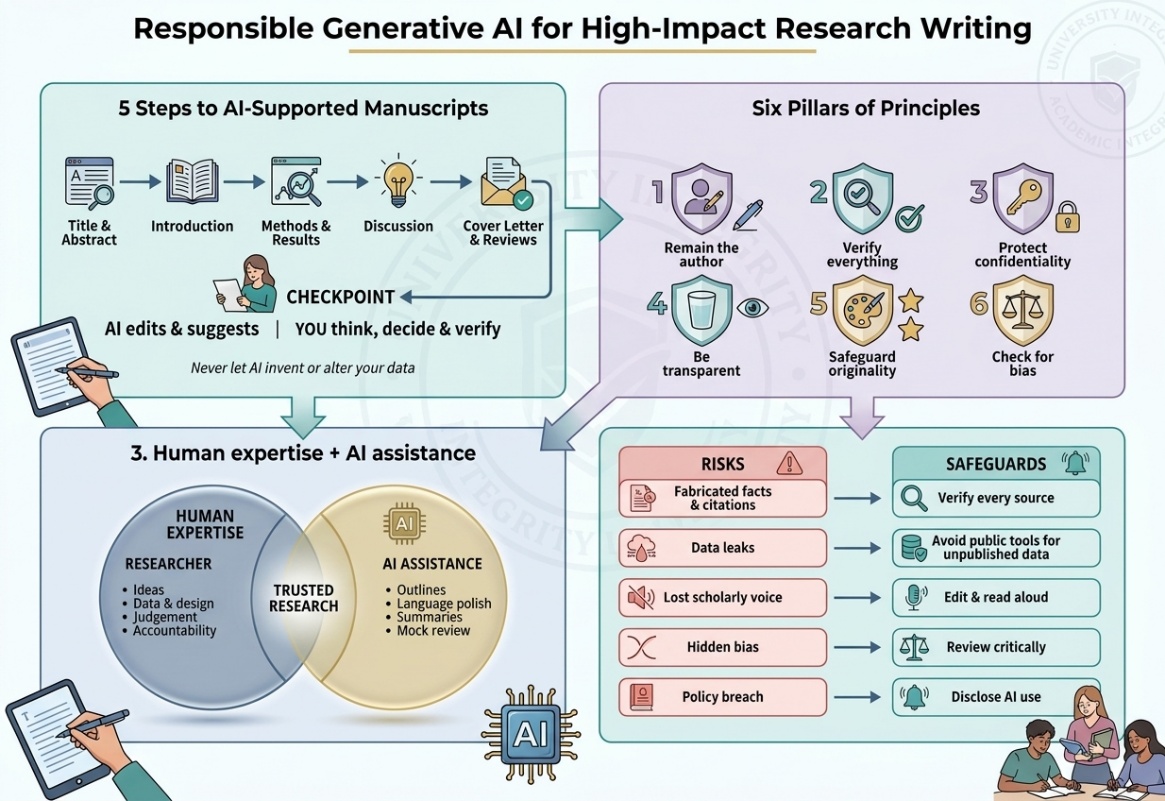
Used well, generative AI acts like a tireless writing assistant. It can suggest outlines when you are stuck, propose alternative titles, and tighten a long abstract to fit a journal’s word limit. It can also rephrase a clumsy sentence so your ideas shine through. For researchers who write in English as an additional language, it can be a powerful equalizer, ensuring that the quality of the science, not the fluency of the phrasing, is what reviewers notice.
Consider how AI can support each stage of a manuscript:
- Title and abstract: generate several options, then choose and refine the one that best reflects your findings.
- Introduction: organize your narrative around the problem, the research gap, and your contribution.
- Methods and results: improve readability and flag unclear sentences, without touching the data itself.
- Discussion and conclusion: help articulate implications and limitations more precisely.
- Cover letters and reviewer responses: draft polite, well-structured replies that you then personalize.
Notice the pattern. In every case, AI supports the writing while the researcher supplies the thinking.
The Risk: When Convenience Becomes a Liability
Generative AI can sound remarkably confident even when it is wrong. It may invent statistics, misattribute findings, or produce citations that do not exist. Left unchecked, these errors can damage a researcher’s reputation and lead to rejection or even retraction.
There are other concerns too. Uploading unpublished data or sensitive participant information to a public AI tool may breach confidentiality. Over-reliance can flatten your unique scholarly voice. And AI can quietly reproduce the biases found in its training data.
These risks are real, but they are manageable with the right habits.
Six Principles for Responsible AI Use
- Remain the author. AI cannot take accountability for your work. You are responsible for every claim, figure, and conclusion. If you cannot defend a sentence, remove it.
- Verify everything. Cross-check every fact, number, and reference against trusted sources before it goes into your paper.
- Protect confidentiality. Never share unpublished findings, personal data, or confidential material with tools whose data policies you do not fully understand.
- Be transparent. A growing number of journals and publishers require authors to disclose AI assistance. Read the author guidelines carefully and include an AI-use statement when asked.
- Safeguard originality. Use AI to refine your ideas, not to generate them wholesale. Run a similarity check before submission.
- Think critically about bias. Review AI-generated text for one-sided framing or unfair assumptions, especially in discussions of people, cultures, or policies.
Getting More from Every Prompt
The quality of AI output depends largely on the quality of your instructions. A few simple strategies make a big difference:
- Give context. Mention your discipline, your audience, your target journal, and your preferred tone.
- Work in small steps. Ask for help with one section at a time rather than an entire paper.
- Treat every response as a first draft. Revise it, question it, and make it yours.
- Use AI as a mock reviewer. Ask it to critique your argument and point out weaknesses before real reviewers do.
- Read your final text aloud. If it does not sound like you, keep editing until it does.
What AI Can Never Replace
No algorithm can design a meaningful experiment, notice an unexpected pattern in the lab, or understand the subtle debates within your field. It cannot feel the curiosity that drives discovery or carry the ethical weight of a conclusion. Creativity, judgment, and integrity remain firmly human, and they are exactly what make research valuable.
AI is a capable assistant, not a co-author and not a substitute for scholarly thinking.
Building a Culture of Responsible Innovation
Universities have a vital role to play in this new landscape. By promoting AI literacy through workshops, clear institutional guidelines, and open discussion, we can empower students, early-career researchers, and faculty to use these tools with confidence and care. When a research community embraces innovation and integrity together, it produces work that is not only well written but also trusted, visible, and influential.
That is how universities build a reputation for excellence, one thoughtful manuscript at a time.
Conclusion: Let AI Amplify Your Voice, Not Replace It
Generative AI is not a shortcut around good research. It is a bridge between great ideas and the readers who need to hear them. The researchers who thrive in this new era will not be those who use AI the most, but those who use it the most wisely: transparent in their methods, rigorous in their verification, and faithful to their own voice.
Your research deserves to be read, cited, and remembered. Let AI help you say it better, and let integrity make it count.
Ready to begin? Pick one section of your manuscript, write one thoughtful prompt, and let your expertise lead the way.
Keywords: generative AI, research manuscript writing, responsible AI, academic integrity, high-impact research, scholarly publishing, AI writing tools

Last Updated: 3 June 2026