
Beyond Strength: How Engineers Design Materials to Survive
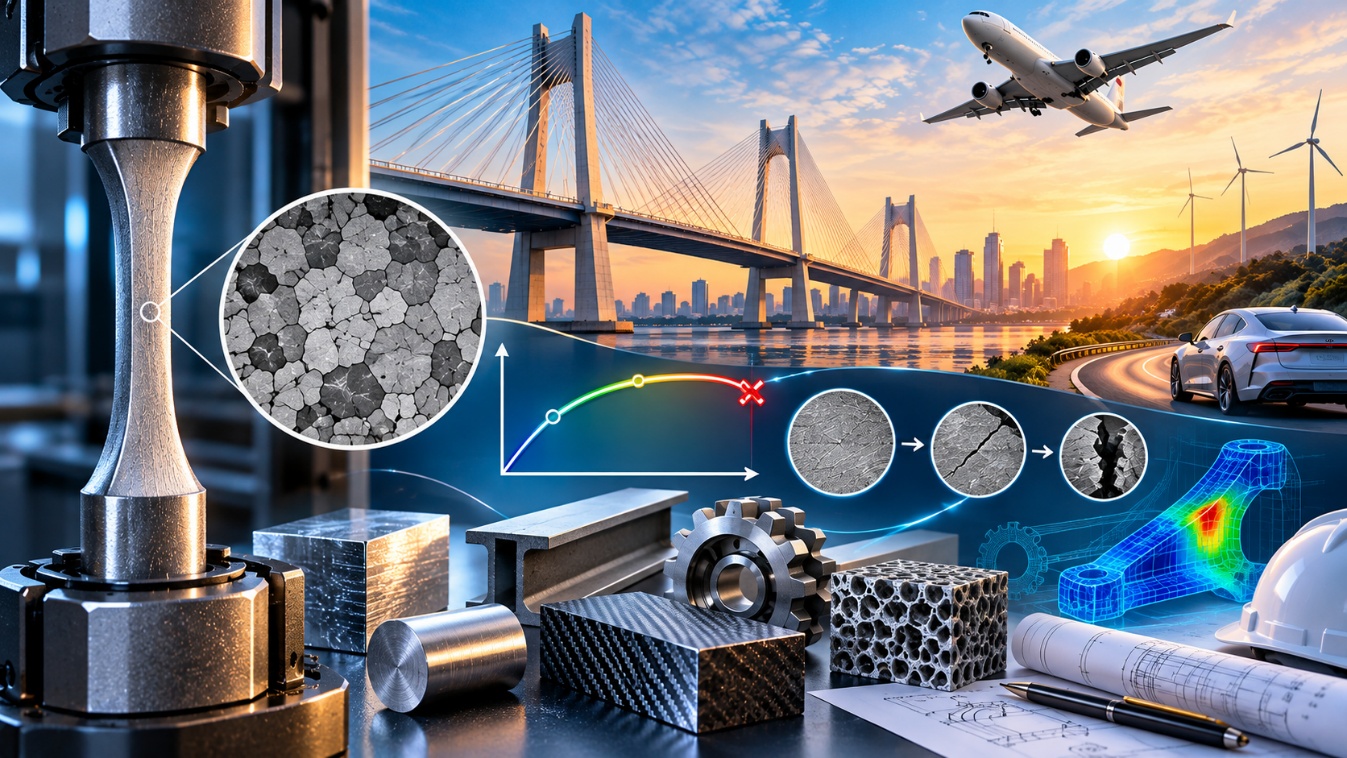
Discover how engineers go beyond strength to design materials that resist fatigue, fracture, corrosion, and heat, keeping structures safe for decades.
Introduction
When we praise a material, we usually reach for one word: strong. Steel is strong. Carbon fiber is strong. Titanium is strong.
But strength alone has never kept a bridge standing, an aircraft flying, or a medical implant working inside the human body for twenty years. Real materials do not fail because they were too weak on day one. They fail because of time, temperature, repeated loading, chemistry, and tiny flaws nobody saw coming.
That is why modern engineers have moved beyond strength. Their goal is no longer to build materials that are merely tough to break. It is to design materials that survive.
Strength Is Only One Chapter of the Story
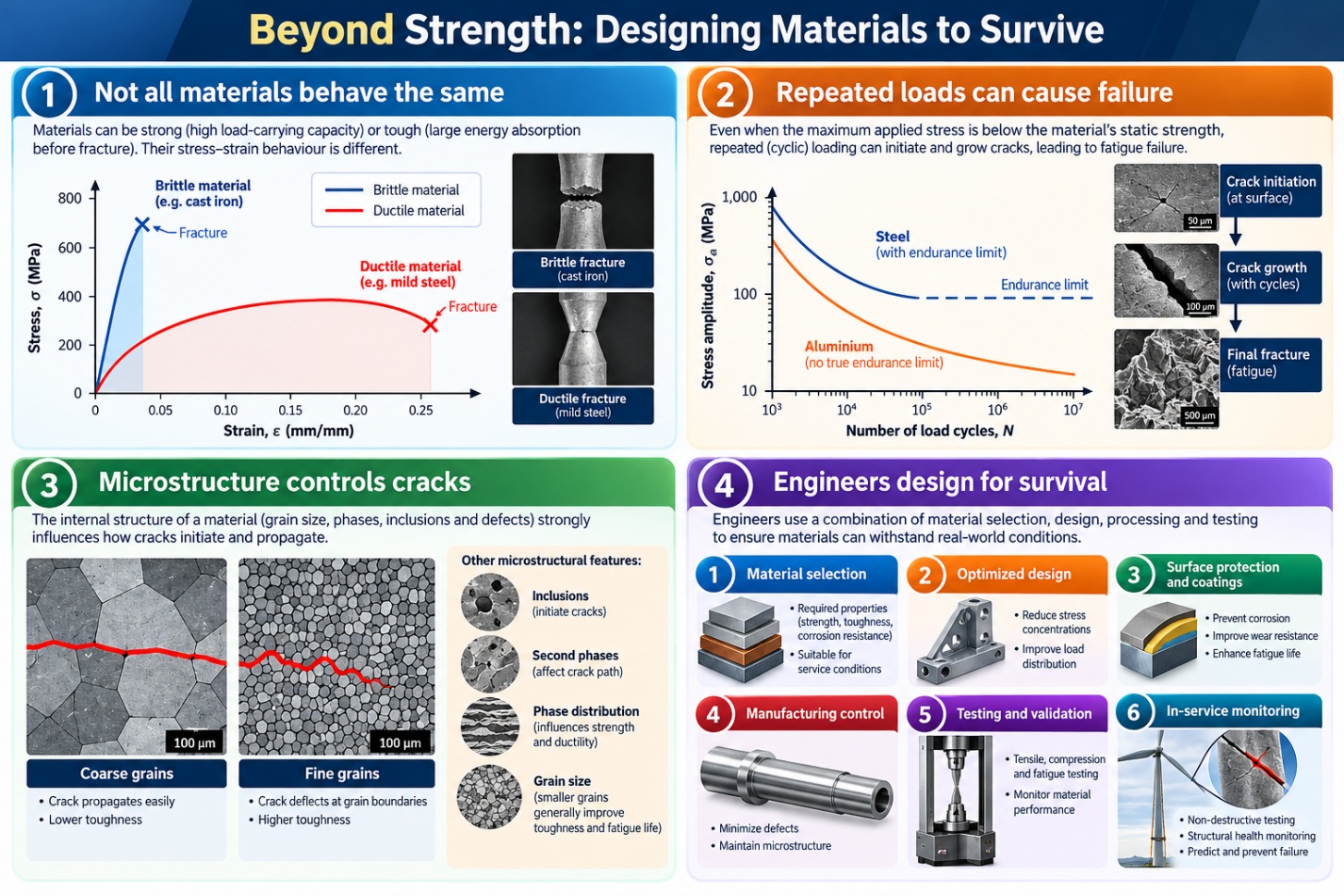
Strength tells us how much load a material can carry before it deforms or breaks. It is a vital property, but it is measured under neat laboratory conditions. The real world is far messier.
A material in service must also be:
- Tough, meaning it can absorb energy and resist crack growth instead of snapping suddenly.
- Fatigue resistant, meaning it can withstand millions of repeated stress cycles.
- Corrosion resistant, meaning it can stand up to water, salt, and chemicals.
- Thermally stable, meaning it keeps its properties at extreme temperatures.
- Durable over time, meaning it resists slow deformation, wear, and aging.
A material can be extremely strong and still be brittle, shattering without warning. Engineers often say that a strong material tells you when it will bear a load, while a tough material tells you when it will forgive a mistake.
Lessons Written in Failure
The history of engineering is also a history of learning from failure. In the early 1950s, the first commercial jet airliners suffered mysterious in-flight breakups. Investigators eventually traced the cause to metal fatigue, where tiny cracks began at the corners of square windows and grew with every pressurization cycle until the structure gave way. Aircraft windows are rounded today because of that lesson.
Similarly, many cargo ships built in the 1940s cracked in cold seas because the steel became brittle at low temperatures. The steel was strong enough on paper, but not tough enough in the conditions it actually faced.
These cases changed how engineers think. Failure is not a rare accident. It is a process that begins at the microscopic level, and it can be designed against.
How Engineers Design for Survival
1. Controlling the microstructure
Every metal is made of tiny crystals called grains. By controlling grain size, heat treatment, and processing, engineers can tune how a material behaves. Finer grains often make metals both stronger and tougher because they make it harder for cracks and defects to move. Think of it as designing the material from the inside out.
2. Smart alloying
Adding small amounts of other elements can transform a material. Chromium gives stainless steel its self-protecting surface layer. Nickel helps steels stay tough at low temperatures. Superalloys used in jet engines keep their shape while glowing hot, conditions in which ordinary metals would soften and sag.
3. Building composites
Why settle for one material when you can combine two? Composites such as carbon fiber reinforced polymers pair strong fibers with a tough matrix. The result is a material that is light, stiff, and resistant to fatigue. Wind turbine blades, aircraft structures, and high-performance sports equipment all rely on this idea.
4. Protecting the surface
Most failures begin at the surface, which is why surface engineering matters so much. Coatings, anodizing, galvanizing, and thin ceramic layers shield materials from corrosion, wear, and heat. A well-chosen coating can multiply a component’s lifetime many times over.
5. Designing out the weak points
Material choice is only half the battle. Engineers also shape components to avoid sharp corners, sudden changes in thickness, and other features where stress concentrates. A smooth radius can matter as much as a better alloy.
6. Testing, predicting, and monitoring
Modern materials are tested for fatigue, impact, creep, corrosion, and thermal shock long before they enter service. Computer simulations now predict how cracks will form and grow. Sensors embedded in bridges, pipelines, and aircraft can even monitor health in real time, so repairs happen before failure.
The Next Frontier: Materials That Heal and Adapt
The future of material design is surprisingly lifelike. Researchers are developing self-healing polymers and concretes that seal their own cracks. Shape-memory alloys return to their original form after bending. Lightweight, high-entropy alloys and 3D-printed lattice structures offer new combinations of toughness and low weight. Meanwhile, sustainability is shaping the field, with engineers designing materials that last longer, use fewer resources, and can be recycled at the end of their lives.
A material that survives longer is not just safer. It is also greener, because the most sustainable structure is the one that does not need to be replaced.
What This Means for Tomorrow’s Engineers
For students and young engineers, the message is clear. Do not stop at the datasheet number. Ask how a material behaves over time, under repeated loads, in harsh environments, and in the presence of flaws. Combine knowledge from physics, chemistry, mechanics, and manufacturing. The most valuable engineers are those who can predict not just how a material performs, but how it will age.
Conclusion: Designing for the Long Run
Strength may win the headline, but survival earns the trust. Every safe bridge, every reliable aircraft, and every long-lasting implant is proof that someone looked past the obvious and asked a harder question: what will this material face tomorrow, and the year after, and the decade after that?
When engineers design with that question in mind, they build more than structures. They build confidence, safety, and a more sustainable world.
Strength gets a material through the first day. Smart design gets it through a lifetime.
Curious about the science behind everyday materials? Look closely at the bridge you cross, the phone you hold, or the plane you board. Survival was designed into every one of them.
Keywords: material design, material failure, fatigue and fracture, corrosion resistance, toughness, composites, materials engineering, advanced materials
Last Updated: 3 June 2026