
Teaching Engineering in Europe and in Bahrain: Different Systems, the Same Goal
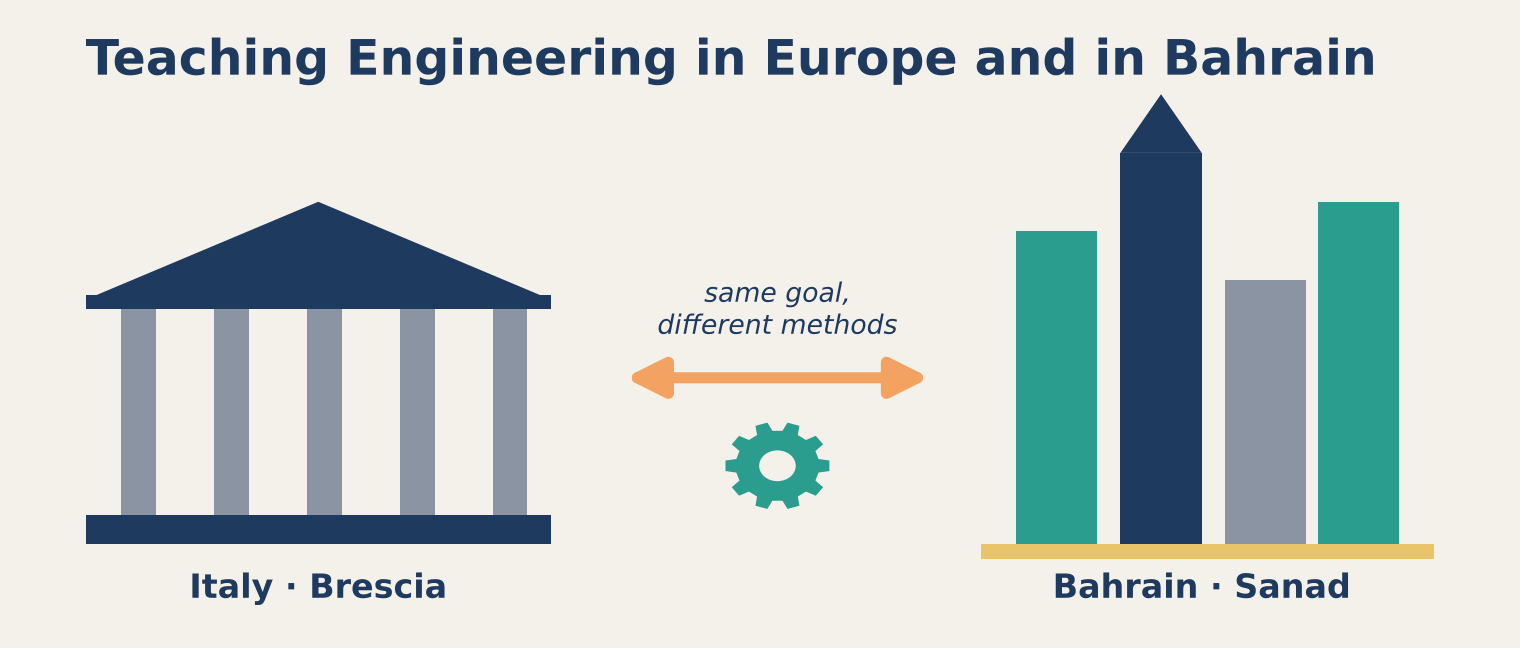
I studied and taught in Italy, and this semester I started teaching mechanical engineering in Bahrain. The two systems are organised very differently, from how exams work to how a course is documented. Each has strengths that the other could learn from.
I spent most of my academic life at the University of Brescia, first as a student, then as a tutor and student coordinator, and finally as a PhD researcher. I also taught technical design and mechanics in an Italian high school. In September 2026 I joined Gulf University as an Assistant Professor of Mechanical Engineering. These are my first impressions after a few weeks. They are personal observations, not a scientific comparison, and they will certainly evolve.
How a course is assessed
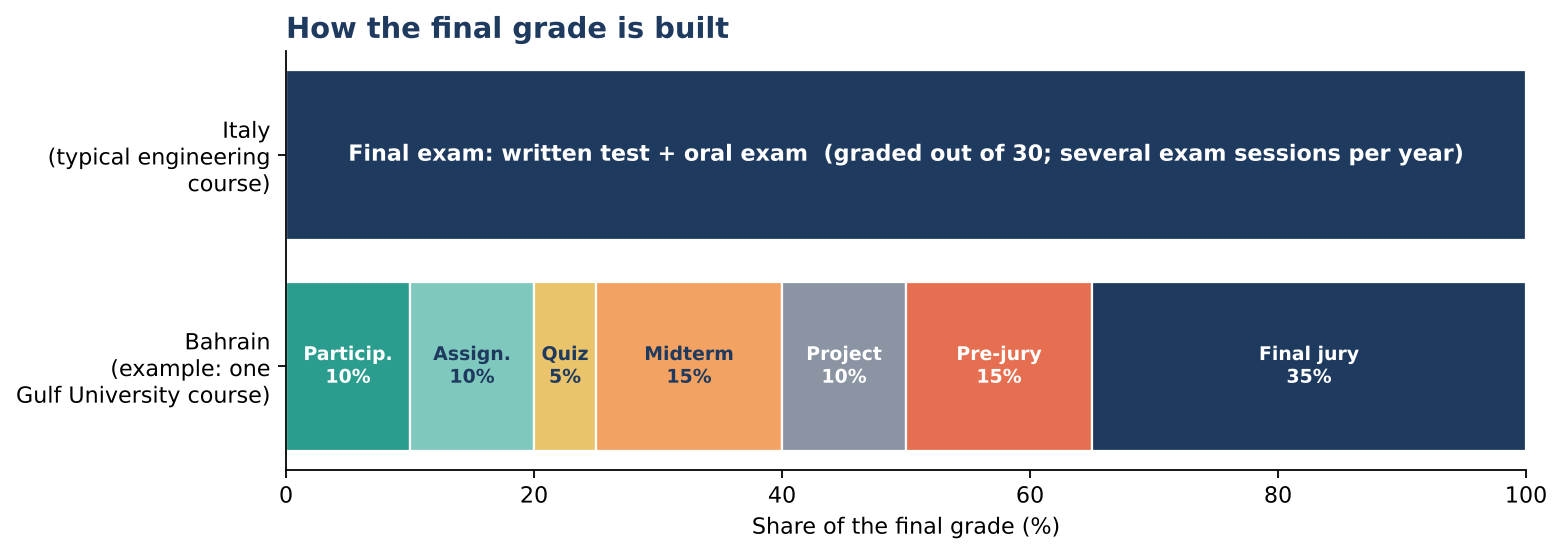
In Italy, the typical engineering course ends with one big moment: the exam. It is often a written test followed by an oral exam, where the professor questions the student face to face, sometimes for half an hour. Grades are given out of 30. Students can usually choose among several exam sessions during the year and can refuse a mark and try again later. Many courses have no compulsory attendance, so the exam carries almost all the weight.
In Bahrain the approach is much more continuous. A course is divided into several assessments with fixed weights: participation, assignments, quizzes, a midterm, projects and a final exam. In one of my courses, for example, the midterm counts for 15% and the project and jury assessments for most of the rest. Attendance is required, and students receive feedback throughout the semester rather than only at the end.
Each model has a clear advantage. The Italian oral exam is a powerful test of real understanding: it is very hard to memorise your way through a conversation with an examiner. The continuous model used here keeps students working steadily and gives the instructor early warning when someone is falling behind. My own preference is to combine the two spirits: frequent, low-stakes checks during the semester, and questions that require explanation, not just calculation, in the major exams.
Outcomes, documentation and quality
The biggest difference I noticed is in how courses are designed and documented. At Gulf University every course has a detailed specification with Course Intended Learning Outcomes (CILOs) mapped to the Programme Intended Learning Outcomes (PILOs). Every exam question is linked to a specific learning outcome, exams are peer reviewed by a colleague before they are given to students, and a course file keeps evidence of the whole process. This follows the national quality framework and international accreditation practices.
In my experience in Italy, quality assurance existed, but much more depended on the individual professor. A course description listed the topics and the exam format, and the professor had considerable freedom in how to teach and assess.
At first, the documentation in Bahrain can feel heavy for a newcomer. But I have come to appreciate it. Linking each question to an outcome forces me to ask whether I am really testing what the course promises. It is very similar to what I did in industry, where every process step had to be traceable to a quality requirement. The system rewards clarity, and students benefit from knowing exactly what is expected of them.
The classroom itself
Italian engineering lectures are often large, and the relationship between professor and student can be quite formal and distant. Here, classes are smaller and the contact is more direct. Students come to the office, ask questions after class and expect the instructor to know them by name. That makes it easier to notice who is struggling and to adapt the pace.
Language also plays a role. In Bahrain engineering is taught in English, which for most students, and for me, is not the first language. This makes clear explanations, simple slides and well-chosen examples even more important. I try to define every technical term, to write key formulas with their units, and to repeat the main idea of a lecture in a short summary at the end. Being a native Arabic speaker who studied in Italian and works in English, I understand how much effort it takes to learn engineering through another language, and I try to make that effort visible and respected in class.
What each system could learn from the other
- From Europe: the habit of asking students to explain their reasoning aloud, and a strong focus on the theoretical foundations of engineering.
- From Bahrain: structured, outcome-based course design, continuous feedback, and a closer relationship between instructor and student.
Neither system is perfect, and both are changing. European universities are moving towards more continuous assessment, while universities in the Gulf are investing in research and in closer links with industry.
The same goal
Despite the differences, the goal is the same in Brescia and in Sanad: to train engineers who understand the principles, can apply them to real problems and can work responsibly with other people. The method changes; the profession does not.
For me, moving between these two worlds has been one of the best lessons in teaching. It reminds me that there is no single right way to teach engineering, but there is always a better way to help a particular group of students learn. Finding it is part of the job.
About the author
Dr. Ahmad Assi is an Assistant Professor of Mechanical Engineering at Gulf University, Bahrain. He holds a PhD in Mechanical and Industrial Engineering from the University of Brescia, Italy, and is a certified Project Management Professional (PMP). Before joining Gulf University he spent six years at Cavagna Group, an Italian manufacturer of LPG and high-pressure gas valves, where he progressed from Process Engineer to Plant Production Manager. He studied and taught in Italy before moving to Bahrain, and is a native Arabic speaker.


Last Updated: 3 June 2026