November 8, 2026
One Election, Two Markets: Why the Gulf Rallied While Wall Street Stumbled
Dr. Tanvir Mahmoud Hussein

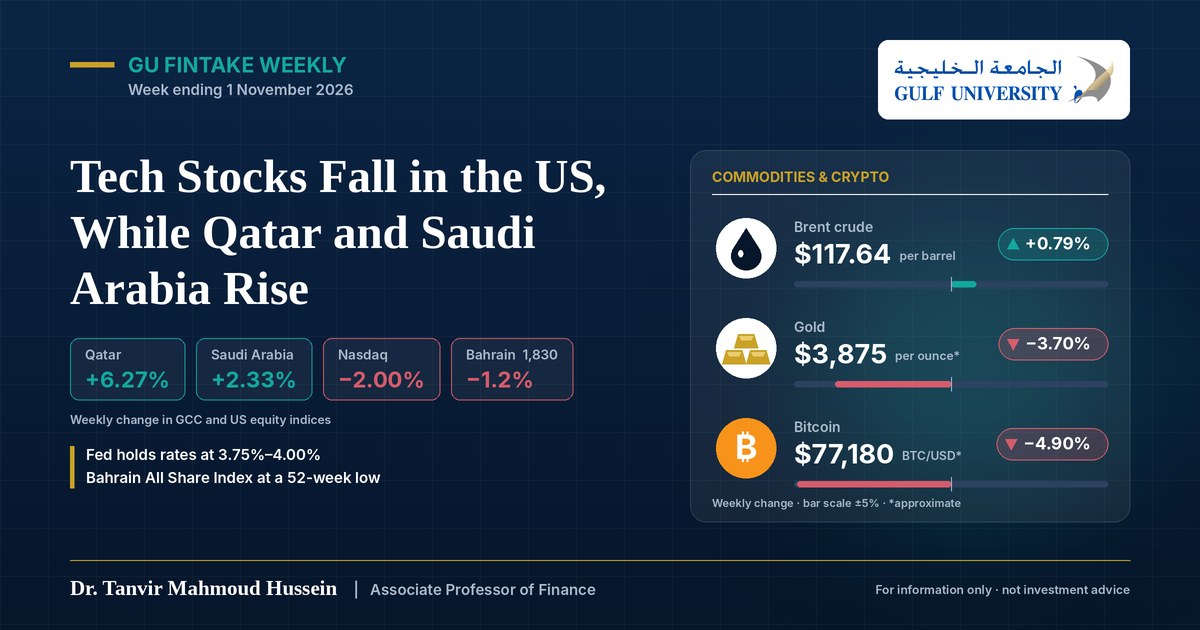
FinTake Weekly from Gulf University (GU) reviews global, GCC and Bahrain stock markets, oil, gold, currencies and key economic news for the week ending 1 November 2026. US and UAE markets closed on Friday 30 October. Saudi Arabia, Qatar, Kuwait, Bahrain and Oman closed on Thursday 29 October.
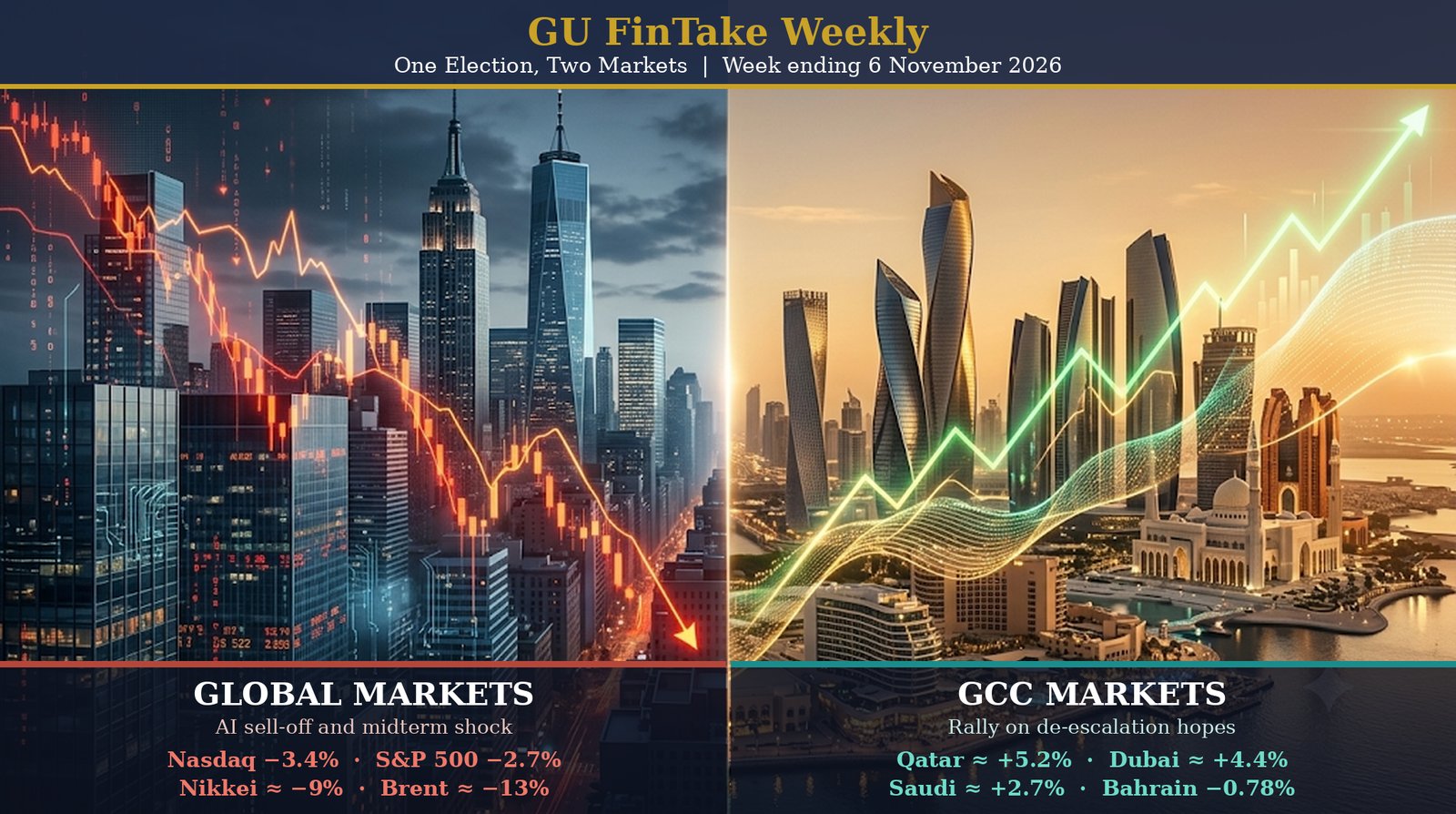
This week showed two different pictures. In the US, a few large technology companies pulled the main indices down, but most other shares went up. In the Gulf, Qatar and Saudi Arabia recovered strongly, while Abu Dhabi, Oman and Bahrain fell. Oil prices stayed high, while gold and Bitcoin fell.
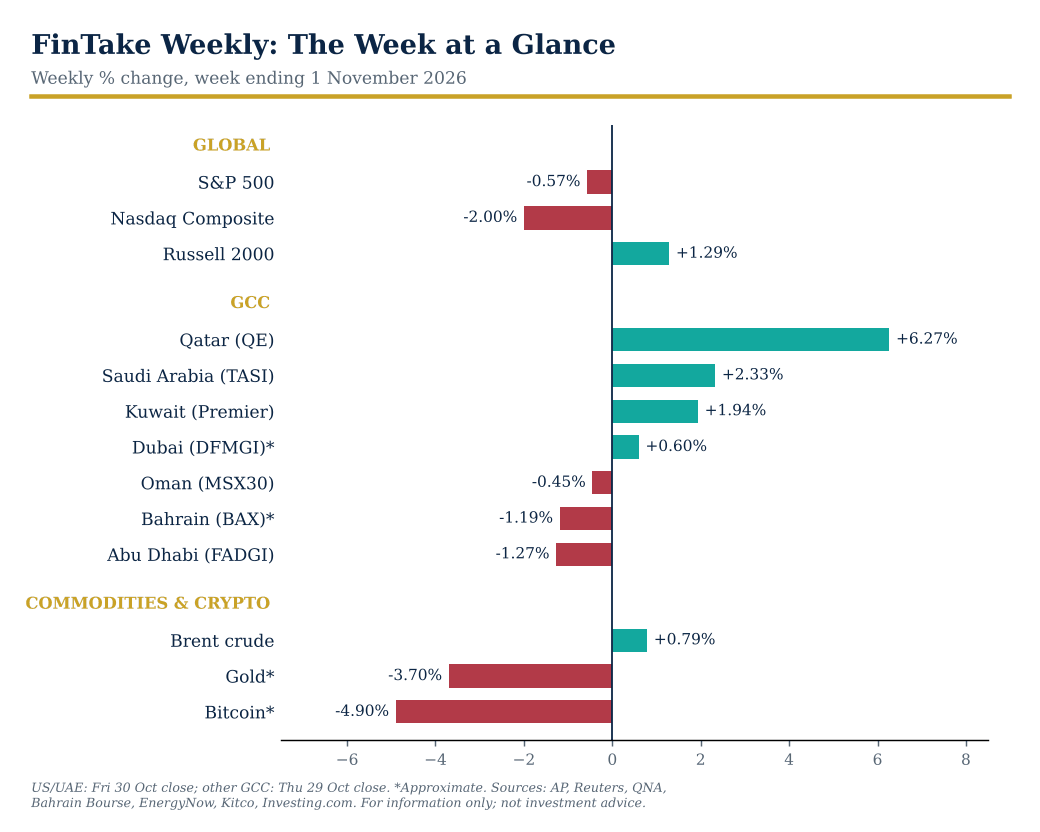
| Market | Close | Closing date | Weekly change |
|---|---|---|---|
| GLOBAL | |||
| S&P 500 | 7,580.07 | Fri 30 Oct | −0.57% |
| Nasdaq Composite | 25,437.00 | Fri 30 Oct | −2.00% |
| Dow Jones | 51,770.31 | Fri 30 Oct | −0.85% |
| GCC | |||
| Qatar (QE Index) | 9,151 | Thu 29 Oct | +6.27% |
| Saudi Arabia (TASI) | 9,922 | Thu 29 Oct | +2.33% |
| Kuwait (Premier) | 8,893 | Thu 29 Oct | +1.94% |
| Dubai (DFMGI)* | ~5,771 | Fri 30 Oct | ~+0.6% |
| Oman (MSX30) | 7,346 | Thu 29 Oct | −0.45% |
| Bahrain (All Share) | 1,830.01 | Thu 29 Oct | ~−1.2% |
| Abu Dhabi (FADGI) | 9,466.34 | Fri 30 Oct | −1.27% |
| COMMODITIES & CRYPTO | |||
| Brent crude (Dec.) | $117.64 | Fri 30 Oct | +0.79% |
| Gold (spot)* | ~$3,875 | Fri 30 Oct | ~−3.7% |
| Bitcoin* | ~$77,180 | Fri 30 Oct | ~−4.9% |
*Approximate. US and UAE markets trade Monday to Friday; other GCC markets trade Sunday to Thursday.
US shares started the week well. The S&P 500 rose for three days in a row. On Wednesday, the US Federal Reserve (the Fed) kept interest rates at 3.75%–4.00%. Two of its members wanted to raise rates, because inflation is still high. New data on Thursday supported this view: the US economy grew 3.4% (annual rate) in the third quarter, and prices rose 3.6% over the past year.
Then technology shares fell sharply. Alphabet, the parent company of Google, dropped 12.6% on Thursday, its worst day since 2004. On Friday, Intel fell 28.6% after a weak forecast, and chip companies as a group fell 7.2%. The S&P 500 had its worst day since June. For the week, the S&P 500 lost 0.57% and the Nasdaq lost 2.00%.
However, the fall came from only a few large companies. Nine of the eleven sectors in the S&P 500 went up, and smaller companies (the Russell 2000 index) gained 1.29%. Investors are worried about spending on artificial intelligence (AI). Last quarter, Alphabet, Microsoft, Amazon and Meta spent about $202 billion on buildings and equipment. This is more than the $176 billion in cash their businesses brought in. The big question now is when this spending will turn into profit.
Qatar was the best market in the region. The QE Index rose 6.27% to 9,151, and all sectors gained. Investors returned to the market, and Doha Investment increased its market support programme from QR2.6 billion to QR5 billion. Saudi Arabia’s TASI fell 2.7% on Sunday, its worst day in 18 months, after Houthi attacks on the Kingdom. But it recovered during the week and closed 2.33% higher. This was its first weekly gain after eight weeks of losses. Kuwait rose 1.94%.
Other markets were weaker. Abu Dhabi fell 1.27%, led by First Abu Dhabi Bank, even though the bank reported higher profits. Dubai rose only about 0.6%, and Oman fell 0.45%.
In Bahrain, the market continued to fall. The official Bahrain Bourse weekly report shows that the Bahrain All Share Index closed at 1,830.01. This is its lowest level in 52 weeks and more than 10% lower than a year ago. Trading was weak, at less than BD 2 million for the whole week. Bank and financial shares made up about 71% of trading and fell 1.34%. Al Salam Bank was the most traded share. GFH fell the most (−4.40%), while Bahrain Kuwaiti Insurance rose 9.52%. The main problem in Bahrain is low trading activity, not heavy selling.
Oil rose for the fourth week in a row. Brent crude (December contract) closed at $117.64 a barrel after new attacks on ships near the Strait of Hormuz. In October, Brent rose about 13.6%. Gold moved the other way. High oil prices make more US rate rises more likely, and this is negative for gold. Gold fell below $3,900 an ounce, its lowest level in more than a year. Bitcoin fell about 4.9% to around $77,200 after the crypto exchange Binance stopped withdrawals while it checks a possible hack. The size of the loss is not yet confirmed. The US dollar was almost unchanged, and the European and Japanese central banks kept their interest rates the same.
The US midterm elections on 3 November are the main event. The US has said it would not attack Iran before the vote, but it has not ruled out action after it. Markets are already reacting: Qatar’s index jumped again on Sunday after talks between Iran and Qatar, and oil fell sharply on Monday on hopes of a deal. On Friday, the US jobs report will show whether the Fed may raise rates again in December.
Disclaimer: This blog is for education and information only. It is not investment advice. Figures for GCC markets other than Bahrain, and for gold and Bitcoin, are approximate and come from Reuters, Qatar News Agency, MarketScreener and other news sources. Bahrain figures are from the Bahrain Bourse Weekly Report (29/10/2026). Past performance does not guarantee future results.
Dr. Tanvir Mahmoud Hussein
Associate Professor of Finance and Head, Accreditation and Ranking Unit — Gulf University, Bahrain
He holds a PhD in Finance, is the author of a book on project management and holds four granted patents. He writes FinTake Weekly to make market developments accessible to students, faculty and the business community.
Last Updated: 10 Nov 2026