July 17, 2026
FinTake Weekly: Dow Edges Higher as Nasdaq Slips on Chip Slide, Oil Surges Toward $85, and Bahrain Rallies on Thin Trading
Dr. Tanvir Mahmoud Hussein

FinTake Weekly from Gulf University (GU) reviews global, GCC, Bahrain, commodities, and currency market trends for the week ending November 6, 2026.
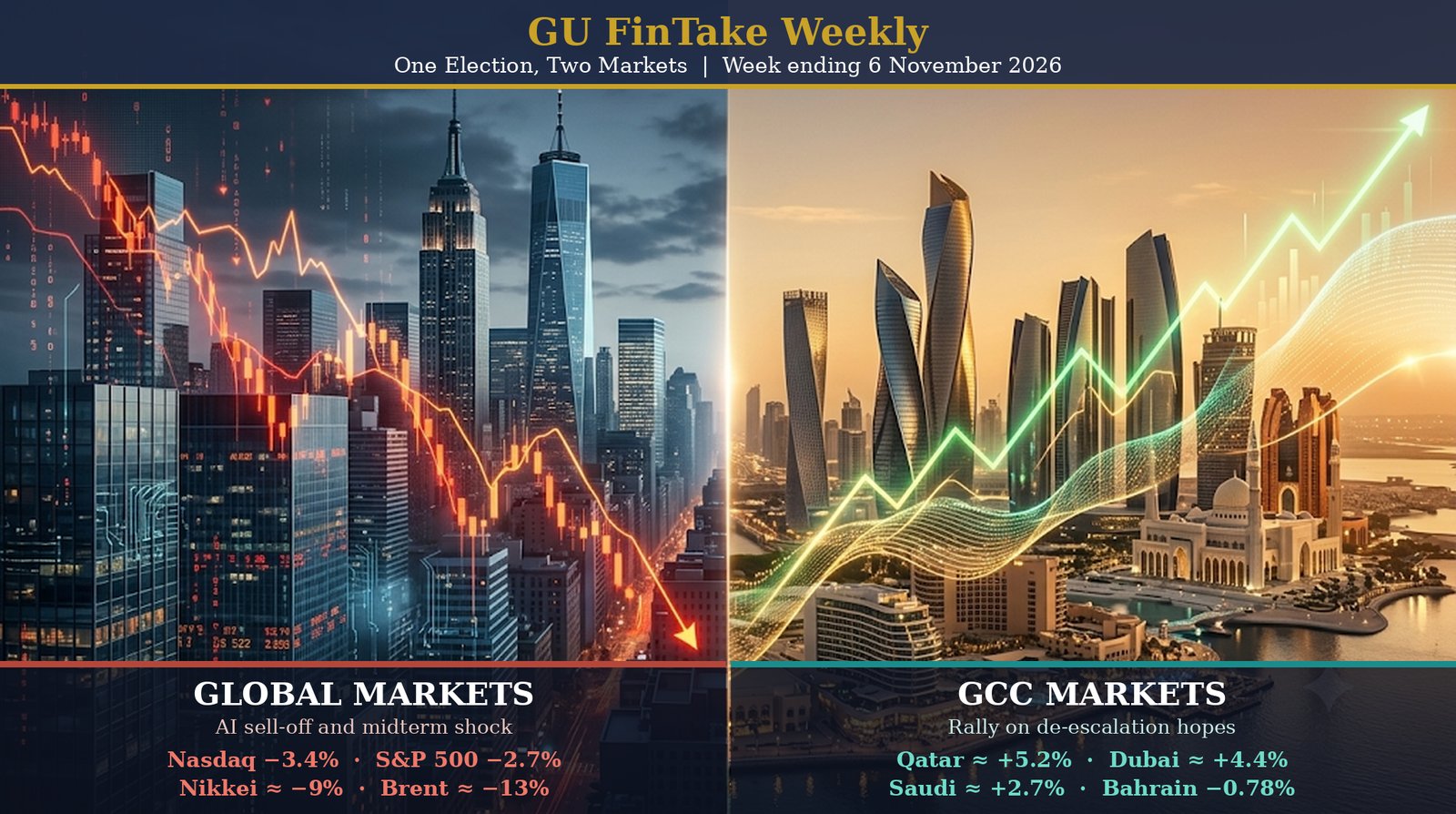
Every so often, a single event sends different markets in opposite directions at once. The week ending November 6, 2026 was one of those weeks. The U.S. midterm elections handed Democrats control of both chambers of Congress, and investors in New York and investors in the Gulf drew very different conclusions from the same result.
For U.S. technology investors, the election raised an uncomfortable question: could a new Congress mean tighter regulation of artificial intelligence and a slower pace of AI investment? That worry collided with already stretched valuations on Thursday, November 5, when the Nasdaq 100 fell 6.4%, its worst day since March 2020, and the PHLX Semiconductor Index dropped more than 12%. Even the broader S&P 500 and the Dow recorded their largest single-day losses since April 2025.
Friday brought some relief, but not enough to rescue the week. The Nasdaq Composite closed at 24,579, down 3.37% for the week and its fourth weekly loss in a row. The S&P 500 lost 2.68% to 7,376, while the Dow, with less exposure to technology, fell a more modest 0.94% to 51,286. A stronger-than-expected jobs report, with 165,000 new jobs against a forecast of about 65,000, added another twist: good news for the economy, but it raised the odds of a Federal Reserve rate increase in December.
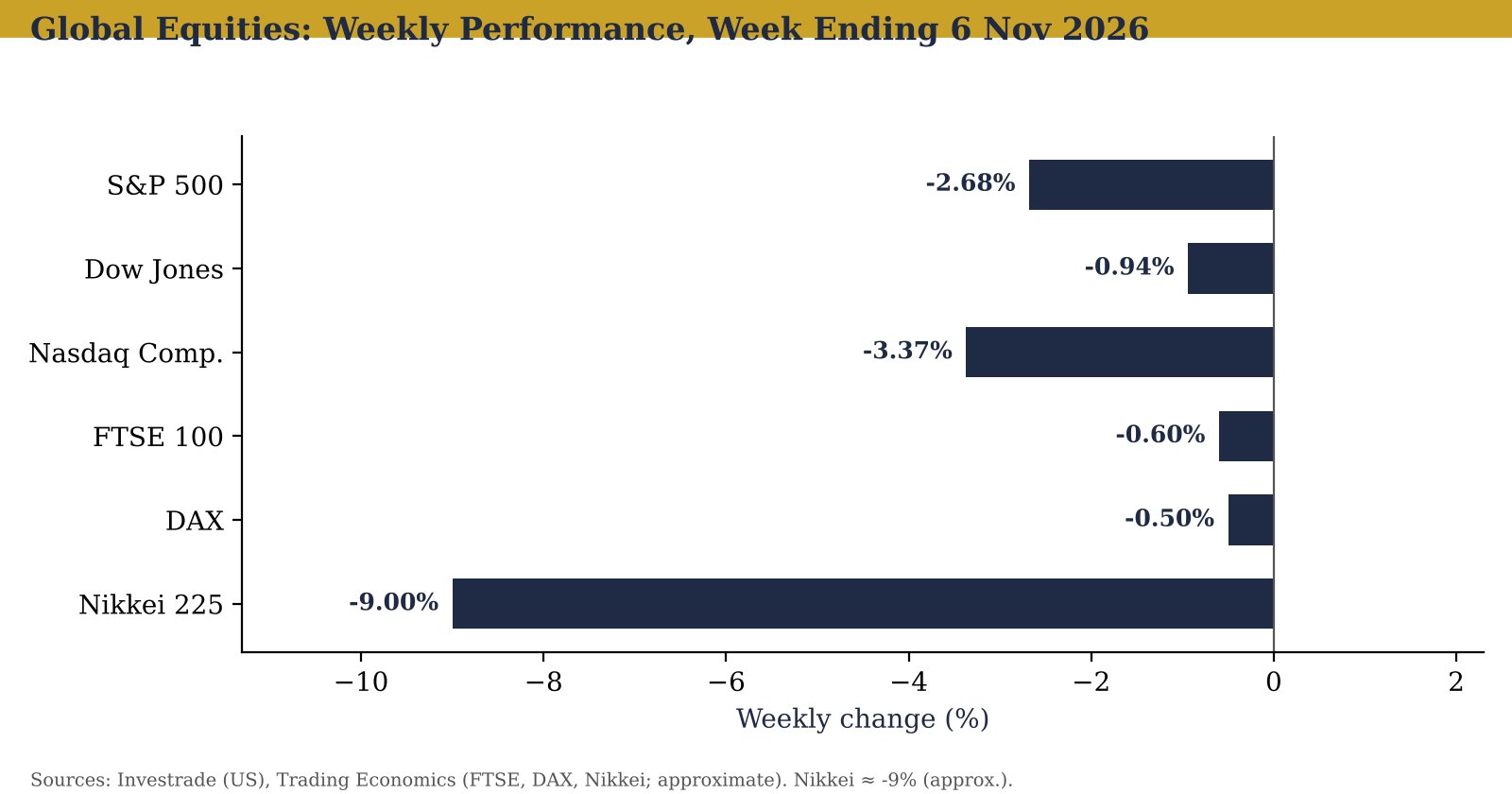
The sell-off travelled quickly. Japan’s Nikkei 225 fell roughly 9% over the week, dragged down by chip-related names, while London and Frankfurt suffered smaller losses. In the UK, the Bank of England raised its policy rate to 4.00%, its first increase since 2023.
In the Gulf, the same election was read mainly through a geopolitical lens. Many investors saw the result as reducing the risk of a wider conflict with Iran, a view reinforced by reports that Tehran had sent a nuclear proposal to Washington through Qatari mediators. That lifted sentiment across most regional bourses, even as oil prices fell.
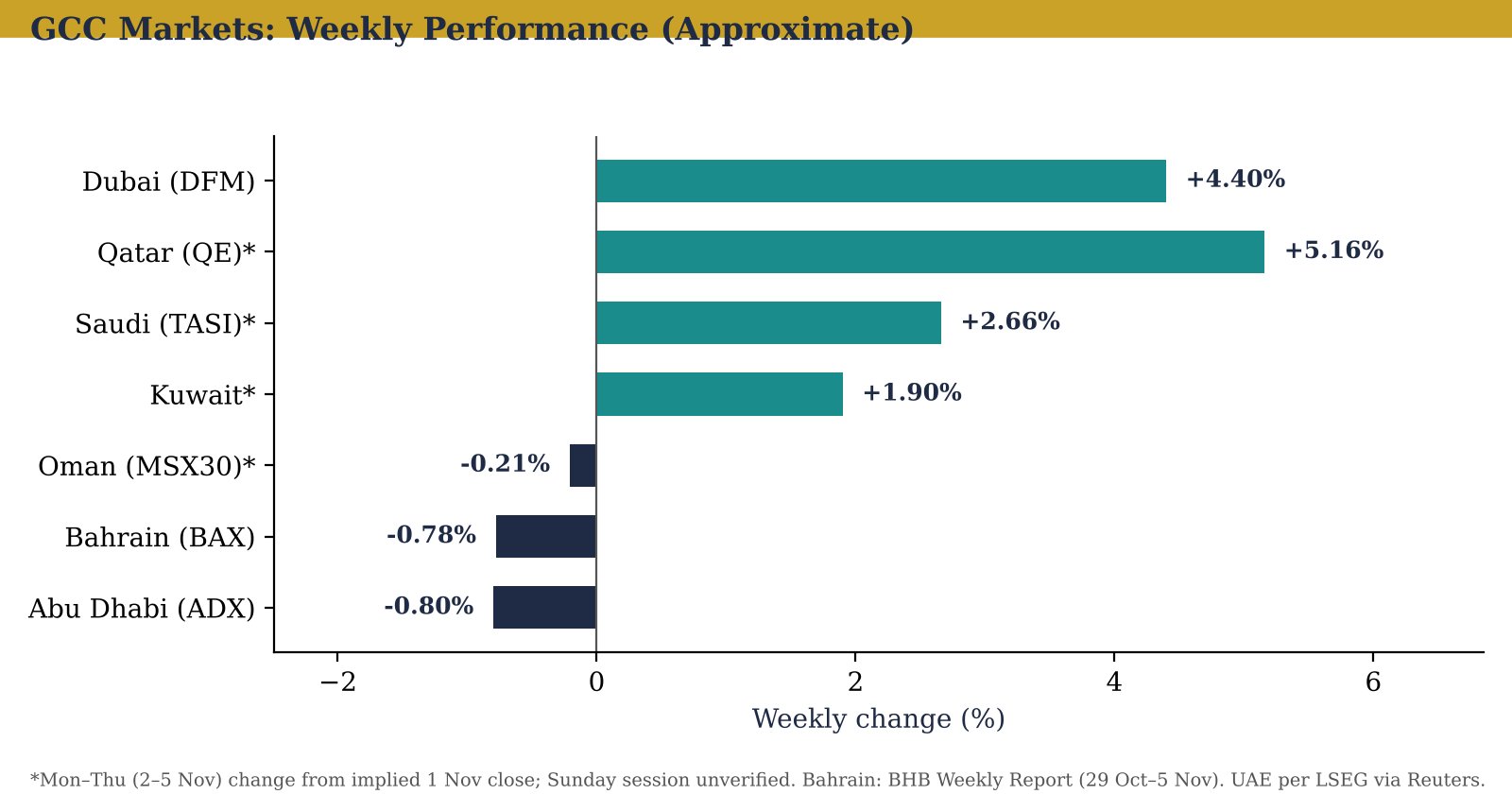
Qatar led the region, with the QE Index rising about 5% from Monday to Thursday to above 10,000, a strong recovery from the multi-year low it touched in late October. Dubai’s DFM index gained about 4.4%, its best week in more than six months, helped by Emaar Properties’ cash offer for the remaining shares of Emaar Development. Saudi Arabia’s TASI climbed back above 10,000, supported by bank shares and a 34.5% jump in Saudi Aramco’s third-quarter profit.
Not every market joined in. Abu Dhabi slipped to an 18-month low on Friday after International Holding Company reported a sharp fall in quarterly profit. In Bahrain, the All Share Index slipped 0.78% to 1,815.75, touching a new 52-week low of 1,813.67, according to the Bahrain Bourse weekly report. Trading activity, however, picked up sharply: turnover rose 57% to BD 3.08 million and volume 80% to 10.78 million shares, led by Aluminium Bahrain, Al Salam Bank and GFH. Alba’s 4.0% fall and a 6.6% drop in Seef Properties pulled the Materials and Real Estate sectors lower.
The most dramatic move of the week came in oil. Brent crude fell about 13% to settle at $98.32 a barrel, its steepest weekly decline since the start of the pandemic, as traders removed part of the war-risk premium built up in recent months. Prices remain high by historical standards, however: attacks on tankers near the Strait of Hormuz continued, and Iran has set conditions before fully reopening the waterway.
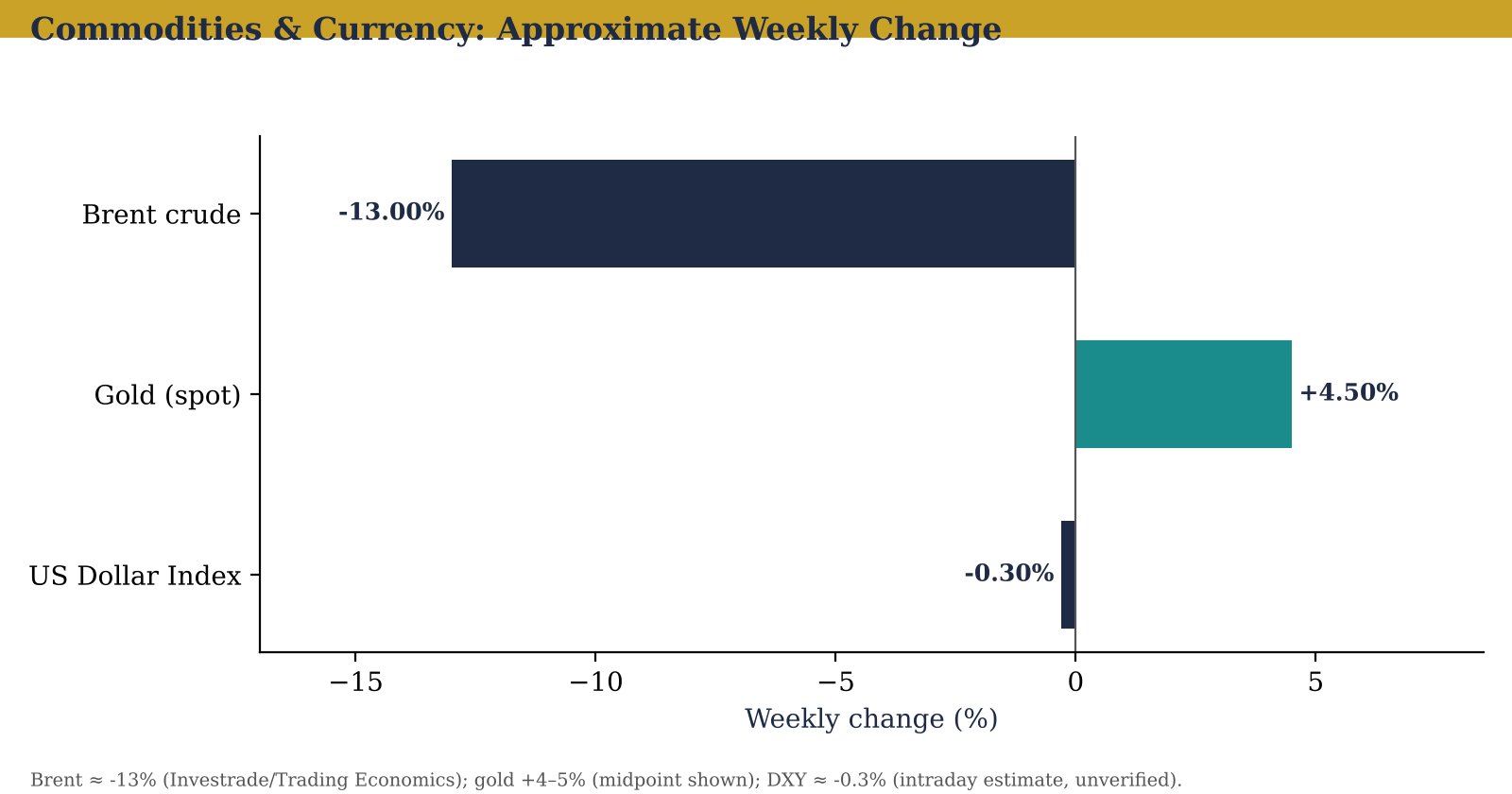
Gold moved the other way, rising around 4 to 5% for the week as investors looked for safety amid the political and market turbulence.
The Dollar Index gained 0.72% on Friday to about 102.28 as the jobs data lifted Treasury yields, leaving it roughly unchanged on the week (an intraday estimate of -0.3%; unverified). Markets priced roughly a 70–80% probability of a 25-basis-point Fed hike in December. GCC currencies pegged to the dollar, including the Bahraini dinar, were unaffected.
Three questions will shape the coming days. First, will the AI correction stabilise? Results from Applied Materials, Cisco and other technology names will be closely read. Second, how will Federal Reserve officials respond to the strong jobs data? Third, can Qatar-mediated diplomacy between Washington and Tehran make real progress? For Gulf economies, lower oil prices reduce revenue, but a durable reduction in regional risk could matter even more for investor confidence.
Disclaimer: This blog is for educational and informational purposes only and does not constitute investment advice. Figures for GCC markets other than Bahrain are approximate; Bahrain figures are official, from the Bahrain Bourse weekly report for the week ending 5 November 2026. Past performance is not indicative of future results.
Sources: Investrade Market Review (6 Nov 2026); Reuters via Business Recorder Gulf market and oil reports (2–6 Nov 2026); Share Talk (6 Nov 2026); Trading Economics market pages (accessed 7 Nov 2026); Bahrain Bourse Weekly Report (week ending 29/10/2026 and 05/11/2026).
Dr. Tanvir Mahmoud Hussein
Associate Professor of Finance and Head, Accreditation and Ranking Unit — Gulf University, Bahrain
He holds a PhD in Finance, is the author of a book on project management and holds four granted patents. He writes FinTake Weekly to make market developments accessible to students, faculty and the business community.
Last Updated: 8 Nov 2026