November 15, 2026
After the Storm: Markets Catch Their Breath as Oil and Gold Retreat
Dr. Tanvir Mahmoud Hussein

FinTake Weekly from Gulf University (GU) reviews global, GCC, Bahrain, commodities, and currency market trends for the week ending November 20, 2026.
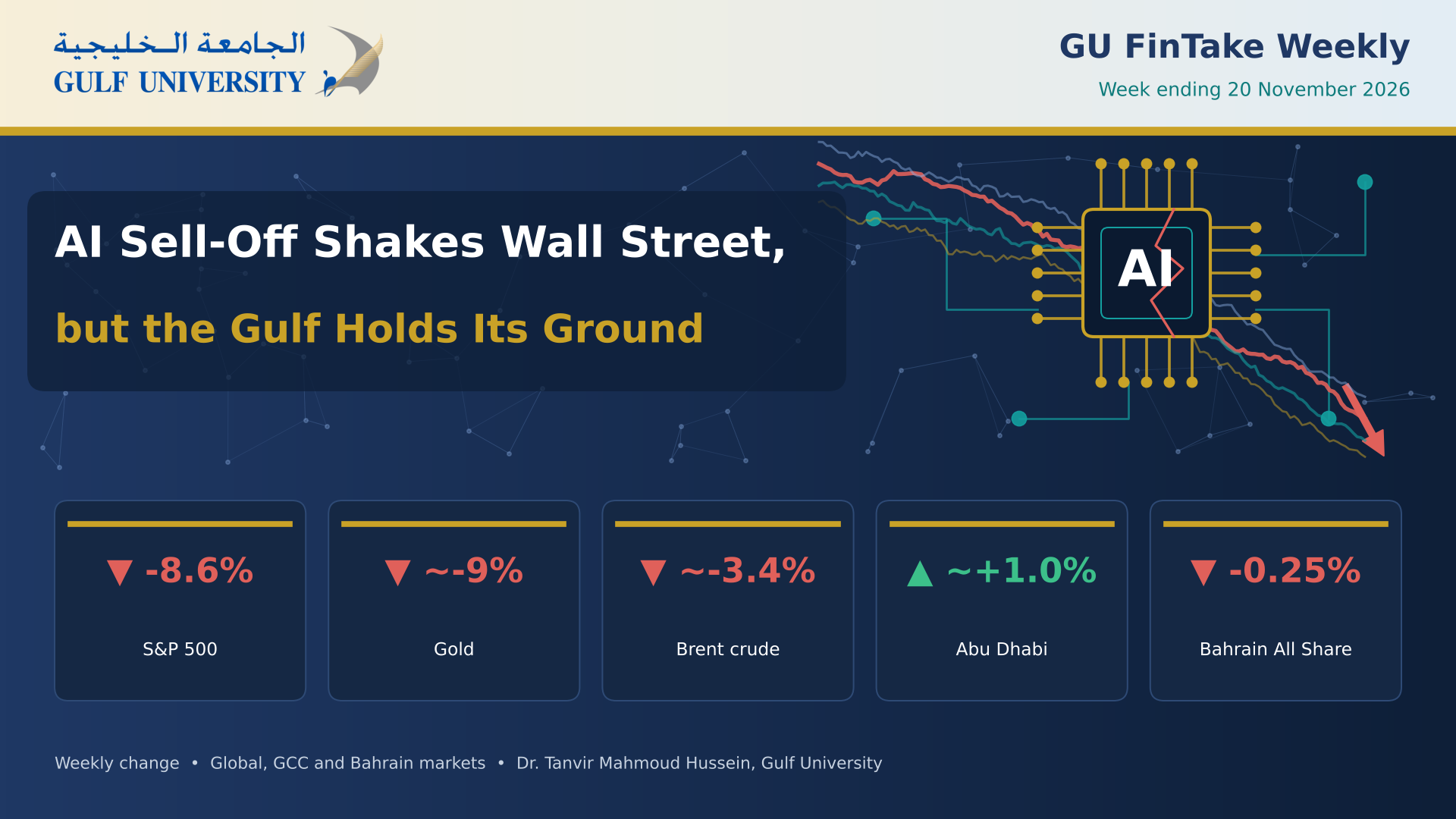
Last week, markets were celebrating a relief rally. This week, the mood reversed sharply. In the five sessions to November 20, 2026, global equities suffered their heaviest losses in more than eighteen months as investors questioned the artificial-intelligence trade that has driven markets for much of the year. Gold, often seen as a safe haven, fell almost as hard. Yet Gulf markets, despite renewed Iranian attacks on Bahrain and Kuwait, ended the week broadly steady.
On paper, the AI sector delivered. Nvidia reported quarterly revenue of $115.8 billion on November 17, more than double a year earlier and above expectations, and raised its guidance. A day later, Anthropic priced its blockbuster initial public offering at $83 per share, valuing the company at about $1.5 trillion. Neither event steadied sentiment. Investors focused instead on stretched valuations, uncertainty over future data-centre spending and Nvidia’s leadership change, and on Friday on reports that U.S. regulators were examining Nvidia’s accounting.
The result was a broad sell-off. The S&P 500 fell 8.6% for the week to 6,910.39, entering correction territory more than 10% below its October record. The Nasdaq Composite lost 10.0% and erased its gains for 2026, while the Dow dropped 8.0%. Friday alone saw the S&P 500 fall 3.7% and Nvidia about 14%, and the VIX “fear gauge” climbed to its highest close since March.
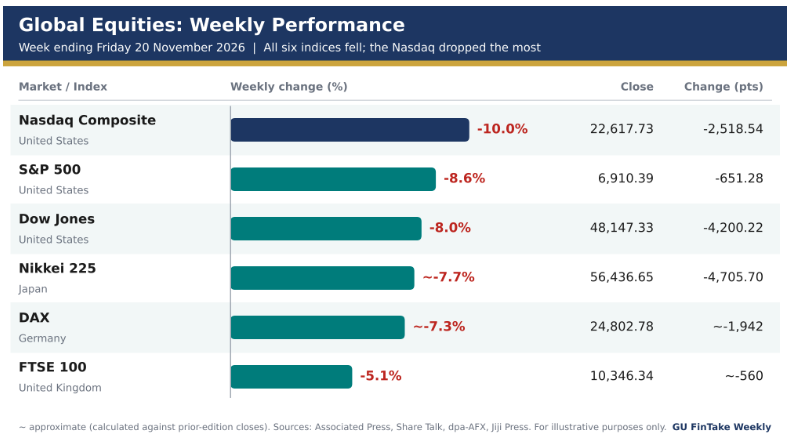
The weakness spread worldwide. Japan’s Nikkei 225 lost about 7.7%, Germany’s DAX about 7.3% (its weakest week in more than a year) and London’s FTSE 100 5.1%. Taiwan’s market recorded one of its worst weeks in decades.
Monetary policy offered no comfort. Minutes of the Federal Reserve’s October meeting and remarks by several officials pointed to further tightening, and markets now treat a December rate increase as close to certain.
Against this backdrop, Gulf markets were notably resilient, although the security situation worsened. Bahrain’s air defences intercepted Iranian aerial attacks on November 15 and again later in the week, Iran targeted a U.S. installation at Kuwait’s Ali Al Salem base, and Houthi missiles were fired at Riyadh.
Abu Dhabi rose about 1.0% and Dubai about 0.5% for the week (LSEG), helped by selected property and telecom stocks. Qatar was little changed after a volatile start, while Oman was reported higher. Saudi Arabia’s TASI was the regional laggard, falling about 1.6% to around 10,159 as Saudi National Bank declined and Aramco traded ex-dividend.
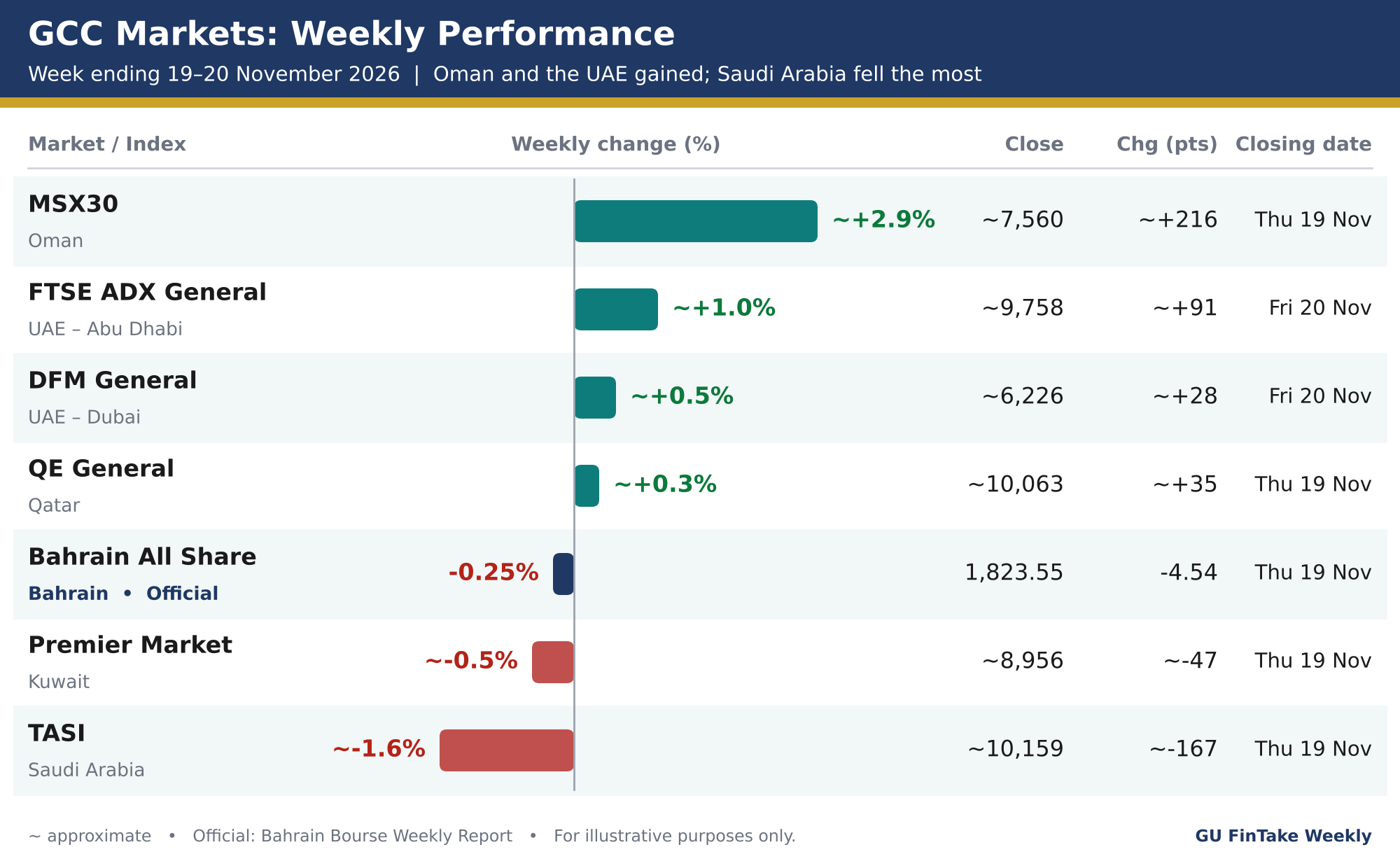
In Bahrain, the official Bahrain Bourse weekly report shows the All Share Index closing at 1,823.55, down just 0.25% for the week and less than 10 points above its 52-week low. Trading value almost doubled to BD 5.1 million, but most of it came from a few large deals in Kuwait Finance House and BMMI, and the number of trades actually fell. Aluminium Bahrain (Alba) rose 2%, while bank shares eased.
Why did the Gulf hold up? Regional markets have little exposure to technology stocks, and investors have already priced in a high level of geopolitical risk after months of conflict.
Brent crude fell for a third straight week, ending near $92.57 per barrel (about -3.4%), as shipments through the Strait of Hormuz returned to roughly pre-war levels, even though attacks on tankers continued. Gold fell about 9% to around $3,535 per ounce, its worst week since March.
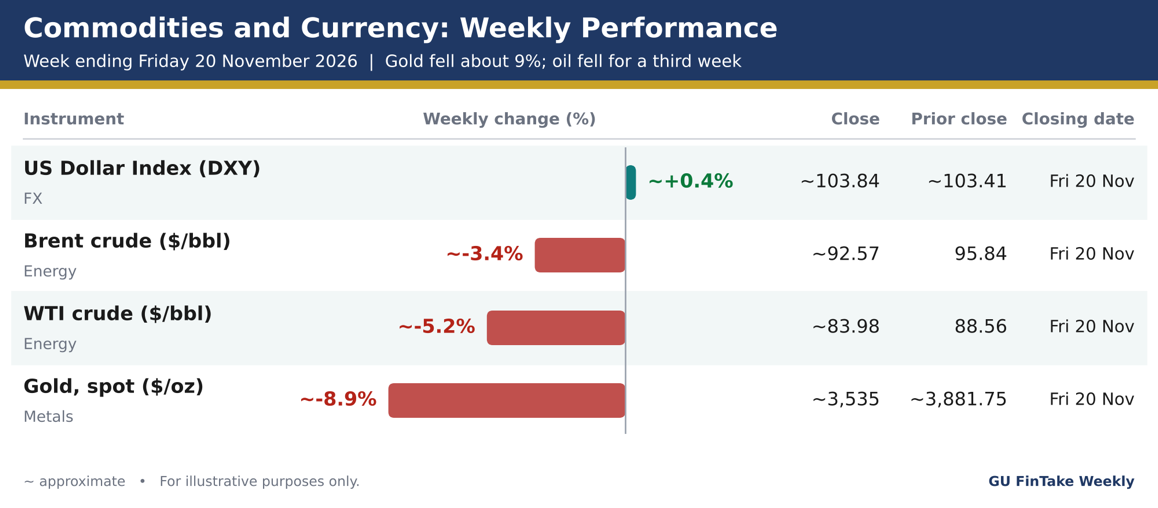
With rate increases expected and investors selling assets to raise cash, the metal did not provide its usual protection. The U.S. Dollar Index edged up about 0.4%.
The U.S. week will be shortened by Thanksgiving, which may reduce trading volumes and make prices more volatile. Investors will watch whether the AI sell-off stabilises, comments from New York Fed President John Williams on Monday, and the OPEC+ meeting on November 29. In the Gulf, the key questions are whether attacks on regional territory continue and whether Bahrain’s index can stay above its 52-week low.
Disclaimer: This blog is for educational and informational purposes only and does not constitute investment advice. Figures for GCC markets other than Bahrain are approximate; Bahrain figures are from the official Bahrain Bourse weekly report. Past performance is not indicative of future results.
Dr. Tanvir Mahmoud Hussein
Associate Professor of Finance and Head, Accreditation and Ranking Unit — Gulf University, Bahrain
He holds a PhD in Finance, is the author of a book on project management and holds four granted patents. Through GU FinTake Weekly, he explains global, GCC and Bahrain market developments in clear, accessible language for students, faculty and the business community.
Last Updated: 22 Nov 2026