
Why Applying AI Is Important for the Interior Design Field
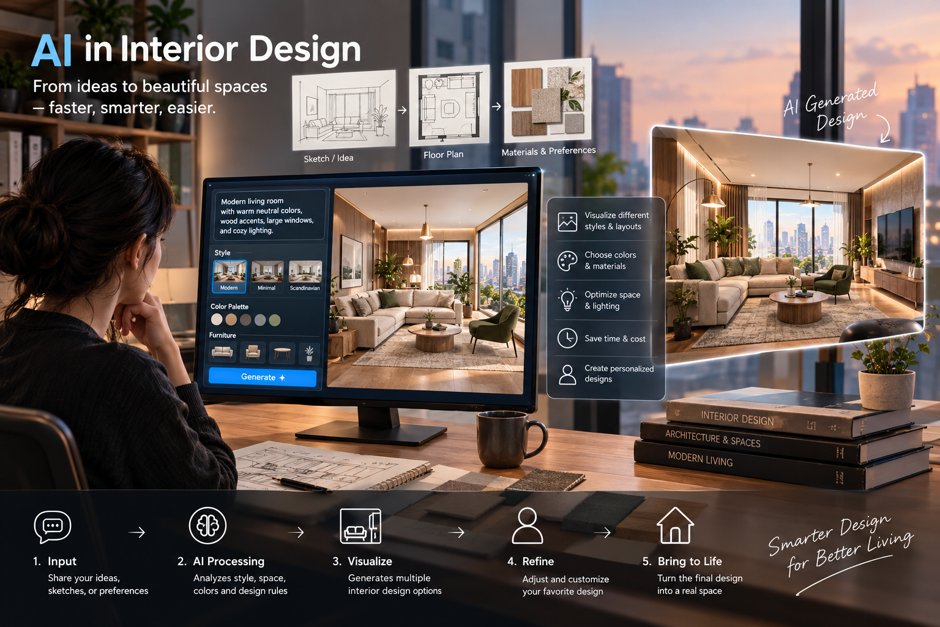
For interior design students, AI is more than just a tool — it is becoming a learning accelerator and creative partner.
By using AI, interior design will be faster, more personalized, and more immersive, helping both professionals and homeowners in Bahrain and worldwide visualize, plan, and optimize spaces with unprecedented efficiency. It is not replacing designers but amplifying their creativity and decision-making power.
The Impacts of AI on Interior Design
- Personalized Inspiration: Platforms generate tailored design ideas based on room dimensions, budget, and style preferences. Mood boards, colour schemes, and furniture suggestions can be customized to individual tastes, democratizing design and making professional-level inspiration accessible to everyday homeowners.
- Efficient Space Planning: AI tools analyse layouts, traffic flow, and functionality to suggest optimal furniture placement. They can even factor in lighting angles, window placement, and energy efficiency for smarter layouts.
- Immersive Visualization: 3D rendering, AR, and VR allow clients to “walk through” their future space before construction. This reduces uncertainty and helps avoid costly mistakes.
- Trend Forecasting: AI uses predictive analytics to anticipate design trends and product demand, so designers can stay ahead of the curve while ensuring timelessness and originality.
- Budget Optimization: AI can recommend cost-effective alternatives for furniture and décor, balancing aesthetics with affordability. This is especially useful for homeowners in Bahrain, where imported furniture can be expensive.
The Challenges and Risks of Using AI
There is a risk of losing the human touch. Recommendations depend on training datasets, which may not reflect local tastes (for example, Middle Eastern design aesthetics), and designers risk becoming passive if they depend too heavily on AI suggestions.
AI is a powerful collaborator, not a replacement. In Bahrain, where design often blends modern luxury with traditional Arabic aesthetics, AI can streamline technical tasks (layouts, renders, sourcing) while leaving the cultural and emotional storytelling to human designers. The best results come from combining AI’s efficiency with human creativity and sensitivity.
The Main Benefits of AI for Interior Design Students
- Instant Visualization: Students can upload sketches or room photos and instantly see multiple design variations. This helps them test ideas quickly without spending hours on manual rendering.
- Skill Development: AI platforms expose students to different global styles (Scandinavian, Arabic, Japandi, Minimalist). They learn how to adapt designs across cultures, which is crucial for international practice.
- Portfolio Enhancement: AI-generated renders can be added to student portfolios, showcasing creativity and versatility. This makes their work more professional-looking and competitive in job applications.
- Experimentation Without Limits: Students can try bold ideas (colours, layouts, furniture) without worrying about cost or feasibility. AI acts as a sandbox for creativity, encouraging risk-taking and innovation.
- Efficiency in Learning: Instead of spending days on one project, students can generate multiple concepts in hours. This accelerates iteration and feedback cycles, making classroom critiques more dynamic.
- Trend Awareness: AI tools often integrate trend forecasting, helping students stay updated on what is popular globally. This prepares them for real-world client expectations.
- Collaboration and Communication: AI-generated visuals make it easier to communicate ideas to peers and professors. Clear renders reduce misunderstandings and improve group projects.
Finally, students should keep in mind that relying too much on AI can make designs look polished but lacking in originality if it is used passively. Cultural sensitivity, emotional storytelling, and unique perspectives are things AI cannot replicate.


Last Updated: 3 June 2026