April 16, 2025
Promoting Sustainable Transportation in Urban Areas: Opportunities and Challenges
Dr. Osama Al Rawi

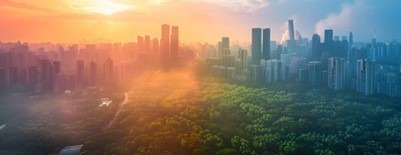
The Urban Heat Island (UHI) effect is a widespread issue impacting numerous individuals worldwide. Cities tend to experience significantly higher temperatures than their rural surroundings, which has a considerable impact on the health and quality of life for urban residents.
Urban areas often create “heat islands” by replacing natural landscapes with heat-absorbing surfaces such as pavement and buildings. This phenomenon leads to increased energy consumption for cooling, higher levels of air pollution, and a rise in heat-related illnesses and deaths. Certain populations including those based on age, race, income, and geographic location, are more vulnerable to extreme heat events. The introduction of green infrastructure, such as vegetation, into urban environments can help counteract the heat island effect and provide cooling benefits to communities.
One of the main causes of Urban Heat Islands is reduction of natural environments in cities. Air cooling is facilitated by trees, plants, and water features through shading, leaf transpiration, and surface water evaporation, respectively. In contrast, urban areas with hard, arid surfaces like rooftops, pavements, streets, buildings, and parking areas offer less shade and moisture than natural settings, thus contributing to elevated temperatures.
Another cause of the UHI effect is the rapid urban construction and characteristics of material used. Common artificial materials used in city environments, such as paving or roofing, tend to absorb and emit more solar heat while reflecting less solar energy compared to vegetation, trees, and other natural surfaces. Heat islands often intensify throughout the day and become more pronounced after dusk as urban materials gradually release the heat they’ve absorbed.
Replacing trees, plants, and water features with hard surfaces eliminates natural cooling through shading and transpiration.
Artificial materials like concrete and asphalt absorb and emit more solar heat while reflecting less energy than natural surfaces.
Narrow streets and tall buildings impede natural wind flow, creating thermal masses that struggle to dissipate heat effectively.
Heat generated by automobiles, cooling systems, buildings, and industrial facilities all contribute to elevated urban temperatures.
Moreover, the size and layout of buildings within an urban area can impact wind patterns and the capacity of urban materials to absorb and release solar energy. In densely developed regions, surfaces and structures obstructed by adjacent buildings become substantial thermal masses that struggle to dissipate heat effectively. Cities with narrow streets and tall buildings create urban canyons, which can impede natural wind flow that would provide cooling effects.
Climate and topography play crucial roles. Calm, clear weather conditions intensify heat islands by maximizing solar energy absorption, while strong winds and cloud cover help mitigate heat island formation. Geographical features can also impact the effect.
Other significant factors contributing to UHI include the use of low albedo materials, human activity, increased air conditioner use, tree destruction, urban canopy formation, wind blockage, and air pollutants.
Daily fluctuations in surface temperatures are generally more pronounced than those of atmospheric air, although they tend to align at night. Water bodies, such as ponds, show less temperature variation throughout the day and night. Urban heat can be mitigated by the presence of parks, undeveloped land, and water bodies, which create cooler zones within cities. The outskirts of cities, where suburban areas transition to rural landscapes, typically experience lower temperatures compared to central urban districts.
As the climate crisis deepens, addressing the urban heat island effect will be vital for making cities more livable and sustainable. By combining urban innovation with natural solutions, cities can tackle this invisible yet powerful challenge and create more resilient urban environments.
Ms. Sandra Job
Gulf University
Last Updated: 09 Apr 2026