
April 27, 2026
The Role of Artificial Intelligence in Achieving Sustainable Development Goals: Towards a Smart and Sustainable Development Model
Dr. Adel Albelal

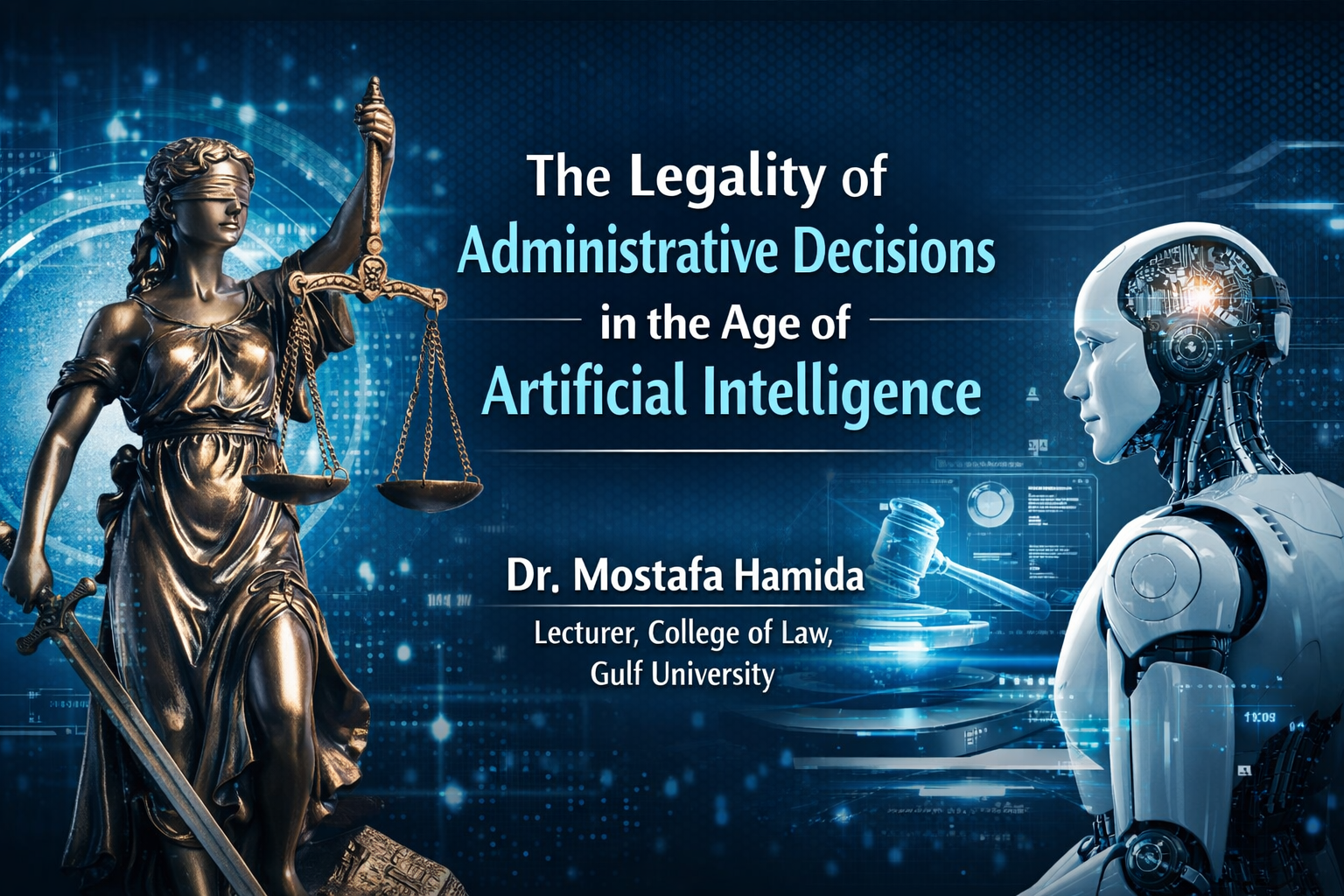
AI is reshaping how administrative decisions are made — and challenging the very principle of legality at the heart of administrative law. Explore the rising tensions around transparency, liability, and judicial review when public authority delegates decisions to algorithms.
Administrative law in the contemporary era is witnessing profound transformations driven by rapid technological advancement, particularly the rise of artificial intelligence (AI), which has begun to permeate the functioning of public administration and directly influence the process of issuing administrative decisions. Administrative decisions are no longer purely the product of human will, as was the case in traditional models; rather, they are increasingly the outcome of automated data processing through complex algorithms.
This development raises fundamental questions regarding the compatibility of such decisions with the principle of legality, which constitutes the cornerstone of administrative law. In its traditional sense, legality requires that the administration be subject to the law in all its actions, whether in terms of competence, form, cause, subject matter, or purpose. Moreover, these actions are subject to judicial review to ensure the protection of individuals' rights and freedoms. However, the incorporation of AI into administrative decision-making introduces unprecedented challenges affecting all these elements, particularly with regard to reasoning, justification, and the effectiveness of judicial oversight.
The algorithms used in administrative decision-making give rise to the issue of transparency. Many AI systems operate through what is known as “black box” models, whose internal logic is difficult to trace or interpret. This creates significant obstacles in verifying the validity of the reasons upon which administrative decisions are based, thereby undermining the requirement of reasoning that enables judges to exercise effective control over the legality of such decisions.
Furthermore, the lack of transparency may lead to violations of the principle of equality if the algorithms embed hidden biases stemming from the nature of the input data or the design of the system. Such biases may result in discriminatory decisions without the possibility of easily detecting or proving such discrimination.
The question of legal responsibility becomes particularly complex in the context of AI-based administrative decisions. When a decision is issued based on automated processing or algorithmic recommendations, it becomes unclear who should bear responsibility for its illegality. Is it the administrative authority that adopted the system, the programmer who designed the algorithm, or the technology provider?
The ambiguity surrounding this issue may weaken the legal safeguards afforded to individuals and calls for a reconsideration of the rules governing administrative liability. This may require the adoption of models such as shared liability or the imposition of objective liability on the administration for damages resulting from the use of such technologies.
There arises the issue of whether traditional mechanisms of judicial review are adequate to address automated administrative decisions. Administrative judges are accustomed to reviewing decisions issued by human authorities, whose intentions and reasoning can be examined. However, decisions generated by AI systems present a different challenge, as they may not easily conform to the same standards of review, particularly given their technical complexity, which may exceed the expertise of the judiciary.
This necessitates the development of new oversight mechanisms, such as the involvement of technical experts, the imposition of legal obligations on administrative authorities to ensure algorithmic transparency, or at least the provision of understandable explanations for algorithmic outcomes.
“Black box” models obscure reasoning and undermine the duty to justify administrative acts.
Hidden biases in data or design can quietly violate the principle of equality before the law.
Authority, programmer, vendor — legal responsibility for automated decisions remains uncertain.
Courts need new tools and technical expertise to review algorithmic decision-making.
Despite these challenges, it cannot be denied that AI offers significant advantages to public administration in terms of speed, accuracy, and the improvement of service quality, thereby enhancing efficiency and effectiveness. However, these benefits must not come at the expense of the principle of legality and the protection of individual rights.
Instead, a careful balance must be struck between technological considerations and legal safeguards. In this regard, a growing trend advocates for the “regulation of administrative algorithms” through the establishment of a legal framework governing their design and use, ensuring their compliance with principles of transparency, accountability, and non-discrimination.
The future of administrative law depends on its ability to adapt to these transformations by developing its concepts and mechanisms in a way that achieves a balance between technological innovation and the rule of law.
In conclusion, the legality of administrative decisions in the age of artificial intelligence is no longer a traditional issue that can be addressed using the same legal tools developed under classical administrative systems. Rather, it requires a re-conceptualization of the principle of legality itself to accommodate modern technological developments. The objective is not to reject the use of AI in public administration, but to regulate it in a manner that ensures the administration remains subject to the law while simultaneously safeguarding individuals against the risks posed by opaque or unaccountable decisions.
Dr. Mostafa Hamida
Faculty of Law — Gulf University
Last Updated: 08 Jun 2026