July 1, 2026
From Smartphone to Studio: Creating Professional Digital Content
Dr. Sherif Badran

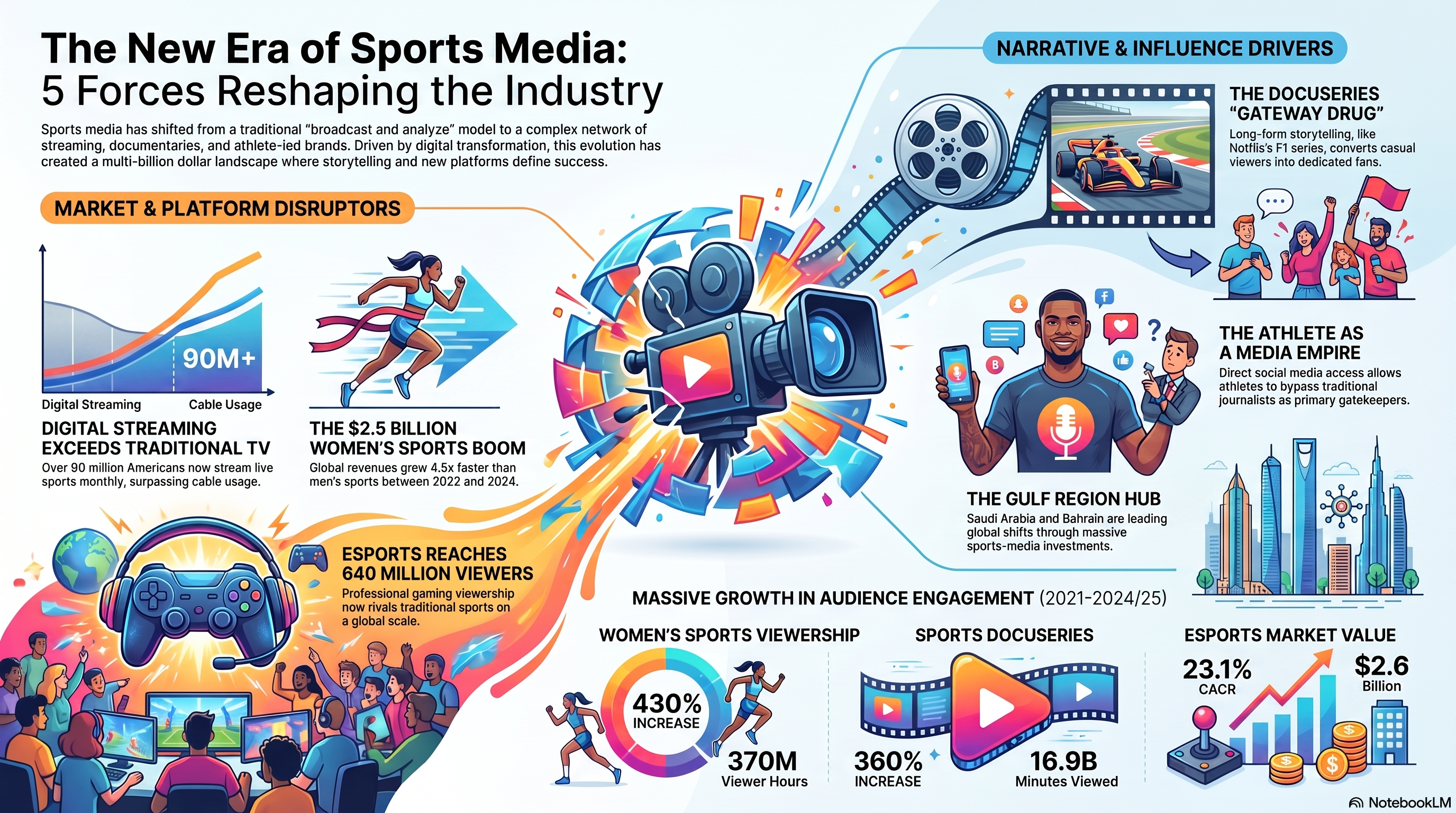
Broadcast the game, add some analysis, repeat — for decades that was the whole business. Today sports media is a sprawling ecosystem of streaming wars, docuseries, women’s sports, esports, and athletes who are media empires in their own right.
For decades, the sports media business followed a simple model: broadcast the game, provide some analysis, and do it again. The football, with its worldwide reach from the Premier League to the FIFA World Cup, was at the center of that model, having the largest audiences, highest expenses on broadcasting rights, and providing the most amount of comments. This time is not over yet, but it went through changes of such a nature that cannot be compared to anything seen before.
At the moment, the sports media becomes a complex network consisting of streaming services trying to get live rights, strong sports documentary and behind the scenes movie market, fast development of women’s sports, emergence of esport as the entertainment genre, and even possibilities for a single athlete to build a media empire using his/her own social networks. Understanding this development is not anymore an issue of sports business experts but should be known by anyone interested in media, communication, marketing, management or public policy studies.
This research analyzes five forces driving the change in sports media, providing evidence for each one and explaining the importance of this development for students and specialists working in the sphere of communications and media in Bahrain and the whole Gulf region.
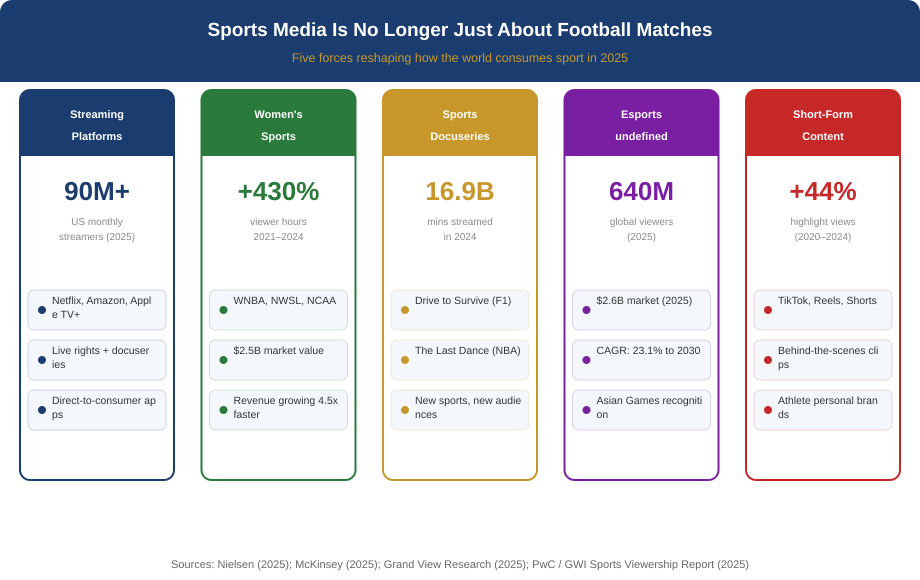
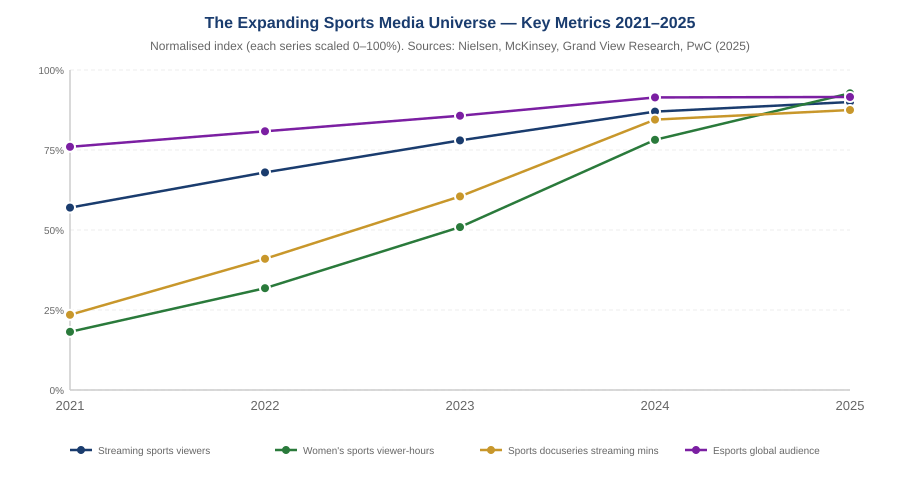
From broadcast television to digital streaming represents the structure on which the bigger changes in sports media have occurred. In 2025, digital sports viewership exceeded traditional television viewership for the very first time ever, which was mainly due to young generations preferring to watch sports via digital streaming services.
There are figures to back up the statement. Over 90 million Americans watch live sports via streaming at least once a month, while in 2021 there were 57 million such viewers. Digital streaming now makes up about 40% of all the television use in the USA, exceeding traditional cable. Also, companies involved in the transition from traditional broadcasting to digital streaming do not belong to the category of traditional broadcasters: Netflix paid $150 million for the two NFL Christmas games and became the only place where viewers can watch WWE Raw since January 2025. Amazon's Thursday Night Football on Prime Video provides live stats, audio choices, and AI replays. MLS ecosystem on Apple TV+ includes more than just matches.
These circumstances create opportunities and challenges for the owners of media rights. The annual investments into live sports media rights in the USA totalled $28 billion in 2024, and the competition from streaming services is increasing their value. For the professionals in the area, the implication is obvious — new skills are gaining relevance.
However, arguably the most significant and overlooked change in recent years, during the last five years, in the field of contemporary sports media regards the fast-growing trend in women’s sports as a profitable and cultural phenomenon. It is no exaggeration to say that the sector is one of the rapidly developing ones in the field of investments into the entertainment industry.
In 2024, the aggregate viewer-hours of the WNBA, NCAA women’s basketball, and the NWSL amounted to around 370 million viewer-hours, showing a 430% growth since 2021. For instance, the 2024 NCAA Women’s Basketball Championship game between Iowa and South Carolina gathered an average of 18.9 million viewers, which is about four million more than in the case of the men’s final. The broadcast rights valuation of the NWSL increased significantly due to the signing of new contracts with CBS, ESPN, Prime Video, and Scripps Sports.
According to McKinsey, the global women’s sports market is estimated at about $2.5 billion and revenue growth of women's sports has been about 4.5 times higher from 2022 to 2024 than that of men's sports. The WNBA new media rights agreement worth approximately $200 million annually has tripled the previous contract of the league and was even higher than the renewal rate in the NBA.
For the people working in the sports media industry, there are both changes and new opportunities here. For example, such aspects as rights valuation, sponsorship strategy, creation of digital content for women’s leagues and audience analytics are popular and relatively available areas of expertise.
The emergence of the sports documentary series can be considered a clear example of contemporary media strategy. For instance, Formula 1: Drive to Survive by Netflix is the best example of it: since it was released in 2019, the show brought more than $290 million of worldwide streaming revenue until 2024 and contributed greatly to the growth of Formula 1 audience in the United States (with an annual increase of 58% in the most successful year) and became one of the factors that inspired hosting of the first-ever Las Vegas Grand Prix.
Sports documentary series demonstrate their success by numbers: overall viewing time of such films increased by almost four times during the last three years from 4.7 billion to 16.9 billion minutes in 2024 on streaming platforms. During the first half of 2025, Netflix ordered 11 sports drama series (which is an increase of almost 200% compared to 2024).
It is worth highlighting the fact that besides numbers the phenomenon in question has another layer of importance. Sports documentaries serve as conversion tools, attracting fans into watching new sports, creating connection with the sport itself, the athletes, and their teams, as well as helping streaming services attract subscribers. Sports documentaries also can be viewed as excellent examples of sports journalism and storytelling, where the long form narrative is applied to sports.
The sports docuseries format provides a great opportunity for the students of media and communication to learn how to engage audience by providing access, developing characters and building the story.
The world of competitive video gaming, or esports, has made the leap from subculture to mass entertainment in record time compared with almost any other form of media ever. Esports viewership in 2025 amounted to 640 million people, putting its viewing numbers on par with those for many sports in the conventional sense of the word. The global esports market had grown to about $2.6 billion in 2025 and is estimated to hit $7.5 billion in revenue by 2030, reflecting a CAGR of 23.1%.
Esports were declared a medal sport at the 2022 Asian Games, while 8,000 American high schools provide official esports activities for students. Traditional media outlets for established sports have taken note of the change in the audience base; ESPN covers major esports tournaments, including the League of Legends World Championship. Twitch comprises 71% of all esports streaming hours, and the number of concurrent users of the League of Legends 2024 World Championship event peaked at 6.9 million.
Media and communication professionals are presented with a unique challenge and opportunity with esports: audience communities expecting their content to be free and accessible online in a frictionless manner, global reach transcending geographical boundaries of broadcasting, and sponsorship networks favoring authenticity over conventional ad forms.
The fifth driving force for sports media is personal to each individual athlete, expressed in their becoming content producers, brand builders, and independent media players. Examples include such athletes as Cristiano Ronaldo with more than 600 million followers on Instagram; LeBron James who together with his partner founded the company called SpringHill Entertainment and worked on The Shop production and other original content; and such women athletes as Naomi Osaka, Simone Biles, and Caitlin Clark who attract media and business attention far beyond their sporting domains.
There is empirical evidence that supports this assertion. According to the survey in the USA, 14% of people claim that they follow sports people or teams on social media rather than influencers (9%). The number of Americans who use social media accounts of coaches increased by 27% in just one year. For sports fans below 35 years old, 53% claimed that smartphones became their main screens for viewing various types of sports content, including live streams, highlights, behind-the-scenes footage, and personal videos from athletes.
This new phenomenon brings considerable challenges to sports journalism and communications. Traditionally, media organizations played the role of gatekeepers between the public and sport events. However, with the appearance of athletes as gatekeepers themselves, media organizations have to compete not only with each other but also with their own subjects of interest. Also, athletes or their communications professionals need skills in content strategy, audience development, and digital storytelling that resemble skills of traditional media workers.
The Gulf region is not an onlooker in relation to global happenings, but rather, plays the role of an active player, while in some ways, a transforming influence on global events. For instance, the Public Investment Fund in Saudi Arabia has invested in sports right and events including LIV Golf, hosting of Formula 1 racing events, and also owning some football clubs. Bahrain has always held the Formula 1 Gulf Air Grand Prix event, one of the most popular sporting events in the region. The Vision 2030 strategies in the region have placed sports, media, and entertainment as key elements of diversification efforts.
This provides a concrete career opportunity for the students of the Gulf University in areas such as media, communication, marketing, or even business. Sports media environment has continued to grow and seeks individuals who combine their skills in media and also in digital space.
These competencies include being able to create communities of audiences on different media platforms, developing stories in sports for digital space, analyzing data from audiences in order to shape content strategy, and communicating with athletes and brands in a media world where speed, authenticity, and quality of storytelling matter.
The world of sports media has moved away from its traditional role as a facilitator between the sport and spectators, to develop into a sophisticated ecosystem comprising aspects such as streaming, storytelling, women’s sports, competitive gaming, and even individual sports people who are media empires themselves. All these areas are growing, attracting funding and creating a need for people who understand business and know how to communicate. Though the game of football, whether it is in the Premier League or AFC Champions League, remains important, an entire media world revolving around the game has been created, providing possibilities just as numerous and diverse as those available in the entertainment industry.
Dr. Sherif Badran
Gulf University, Bahrain
Last Updated: 07 Jul 2026
