June 23, 2026
The Hidden Psychology Behind Viral Social Media Content
Dr. Sherif Badran

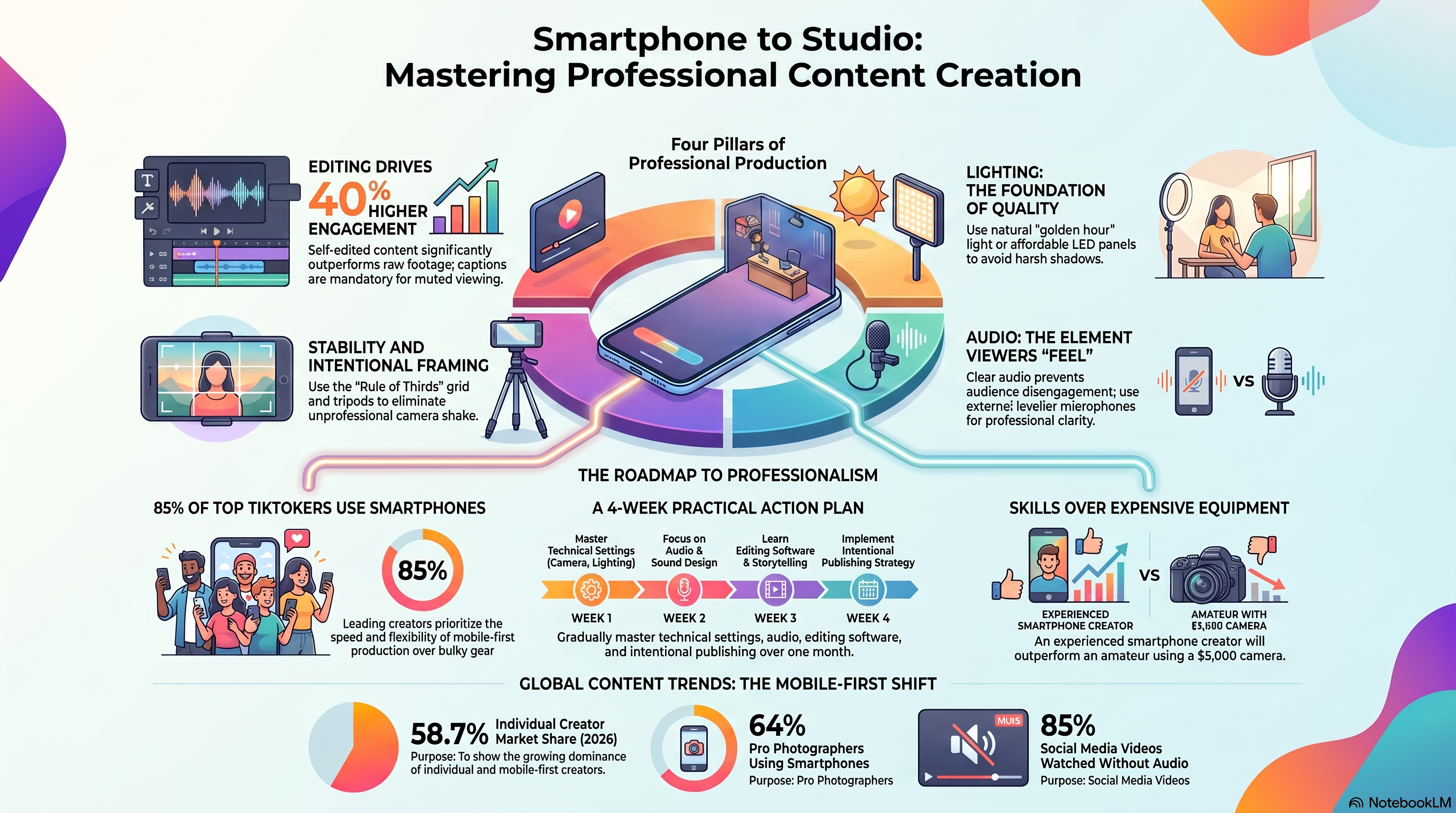
A film crew, expensive cameras, and studio space were once the price of professional video. Today the device in your pocket can rival them — if you master the craft of lighting, audio, framing, and editing.
This change represents a substantial step up in professional content creation. Traditionally, generating professional video or photography required a whole film crew, expensive cameras, studio space, and long-term training in the relevant skills. Today, this level of quality can be achieved using an object which almost everyone carries on themselves — the smartphone. Modern smartphone became a very powerful tool for content creation, and the mastery of this tool became a valuable transferable skill applicable almost everywhere professionally.
These empirical observations demonstrate the changing trends. According to projections, in 2026, individual creators will comprise 58.7% of the total content creation market with the help of generative AI and mobile-first tools reducing the barriers previously restricting professional production. Furthermore, over 85% of top creators on TikTok use smartphones as their main camera, not out of the lack of options, but because of speed and flexibility of mobile-first production and increased capabilities to compete with professional equipment.
The article offers a practical guide for the students and professionals of Gulf University who want to move from their daily use of the smartphone to the purposeful creation of high-quality digital content. The general principles of the process described below can be applied universally regardless of the goal — either personal branding, improvement of communication within organizations or preparation to a career in media industry.
The modern flagships—such as the iPhone 15 Pro, Samsung Galaxy S24 Ultra, and Google Pixel 8 Pro—are able to perform functions such as 4K video recording, optical image stabilization (OIS), computational photography, and scene optimization powered by AI that have not been offered by professional broadcast cameras ten years ago. According to current statistics, 64% of professional photographers use their smartphones to capture over half of their images, and the ratio grows rapidly.
However, smartphones have their drawbacks; specifically, they cannot offer a lot of optical zoom without degradation due to digital zoom, they tend to overheat when recording 4K for long periods of time, and they are unable to compete with large sensors in extremely low light situations. The best way to create content is to combine these two approaches; thus, the use of smartphones for fast creation of content, such as Reels, TikToks, and Stories, and the use of cameras for high-quality productions.
The key idea is that equipment does not usually distinguish between good content and great content. What makes the difference is production skills—lighting, sound, framing, editing, and story. An experienced creator working with his/her smartphone will beat a non-experienced creator working with a $5,000 camera.
Of all variables in video and photography production, lighting is the most revolutionary one. A well-lit scene produced on a five-year-old smartphone will always beat a poorly lit scene produced using the newest flagship model. However, there is no need to spend money to get quality lighting in your shots.
First of all, natural light is the most efficient and budget-friendly source of light. It should be positioned in such a way that the subject faces the window that gives diffused light, like when it is covered by a translucent curtain. Do not shoot with the powerful light coming from behind the subject, since this will result in silhouettes.
Golden hour (the period just after sunrise and right before sunset) produces a flattering, warm, and cinematic light suitable for outdoor shooting.
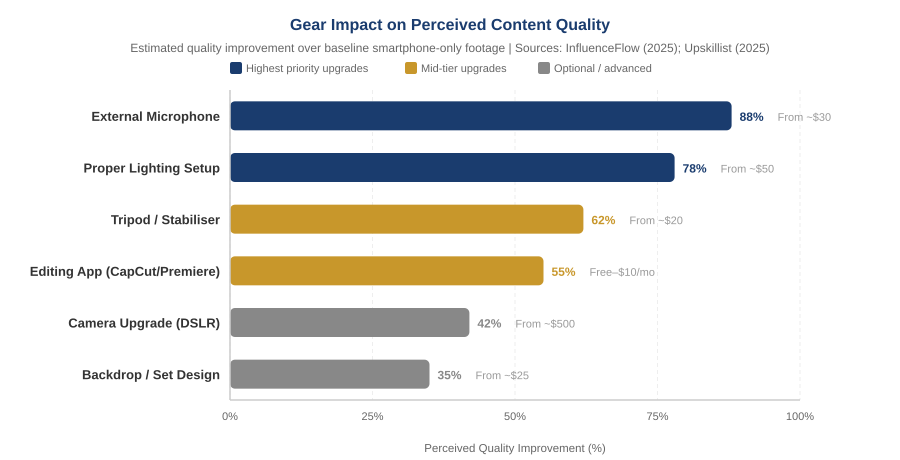
To get good lighting indoors or in the evening, one can use an affordable LED panel light or ring light ($50-$100). Three-point lighting (light in front, side light, and backlight behind the subject) reduces the number of sharp shadows.
Do not combine different colors of light, as it will be quite hard to fix the orange color cast of house lamps with the cold light of daylight in post-editing.
Poor audio is the fastest way of causing the audience to lose interest. Studies have shown time and again that people can put up with some visual imperfections and slight camera shake, but once the audio becomes unclear, hard to understand, muffled, or has a lot of reverberations, they become disengaged with the content. When video content producers invest in audio quality, they get much more attention from the audience at a minimal cost.
The built-in microphone in smartphones usually records ambient noise of the room, reverberations, and handling noises. An inexpensive ($30) external lavalier microphone makes your voice clearer.
When you need studio-quality audio for talking head presentations or interviews, there are wireless lavalier microphones such as Rode Wireless GO II that cost much less than the broadcast-standard microphones.
Recording should be done in a room where there is furniture made of soft materials, because they help to absorb sound and prevent reverberations. It is better not to record in a room that has a lot of tiles or glass surfaces.
You need to pay attention to audio levels before recording. Ideal waveforms should peak between -12 dB and -6 dB.
Unsteady video production communicates the unprofessional approach to viewers right away, even when the viewer does not necessarily state why he or she thinks that way. Steadiness and framing techniques are standard approaches that do not involve sophisticated abilities and can be achieved without spending much money.
Purchase an inexpensive tripod or tabletop stand ($20) to stabilize your video and create steady shots. For dynamic videos, purchase a gimballed stabilizer ($80-$150) that creates cinematic motion.
Shoot landscape (horizontal) format for YouTube and LinkedIn and professional presentation videos. For TikTok, Instagram Reels, and Stories shoot portrait (vertical) format. Do not change formats in your video production.
Apply the rule of thirds and place the subject of your interest at the intersection of the 3x3 grid placed on top of the frame, rather than in its center. The configuration is more dynamic. Turn the grid feature on in your smartphone camera settings.
Maintain headroom above your subject but avoid leaving too much space above, shoot from eye level when filming talking heads, and make sure your background serves the purpose, a messy background takes away from the message you want to convey.
The process of editing goes beyond being just a process; rather, it becomes an opportunity for a narrative to form. As per the 2025 Content Trends Report published by Adobe, those creators who conduct self-editing of their content see audience engagement levels that are about 40% higher than those seen by those who post unedited videos.
CapCut (free) — This app is considered the best editor for short-form content, as it offers AI-based auto-captions, templates, color correction, and 4K exporting. Most of TikTok and Reels creators use it.
Adobe Premiere Rush — This software allows both mobile and desktop editing and helps start the project on a mobile device and continue working on it on a PC. Multi-track audio, color grading, and professional transitions are offered.
DaVinci Resolve (free desktop) — This is professional-level software used by Hollywood editors. If you value color grading and creating long-form content of high quality, no other program can offer such capabilities at such price.
Captions and subtitles are now mandatory. Studies show that 85% of all social media videos are watched without audio. Auto-captioning is available in CapCut, Descript, and Adobe Premiere, which makes it easy and fast.
Professional content creators — regardless of budget — follow a consistent production pipeline. The difference between reactive, inconsistent posting and a sustainable content strategy lies in treating each piece of content as a managed project, not a spontaneous act.
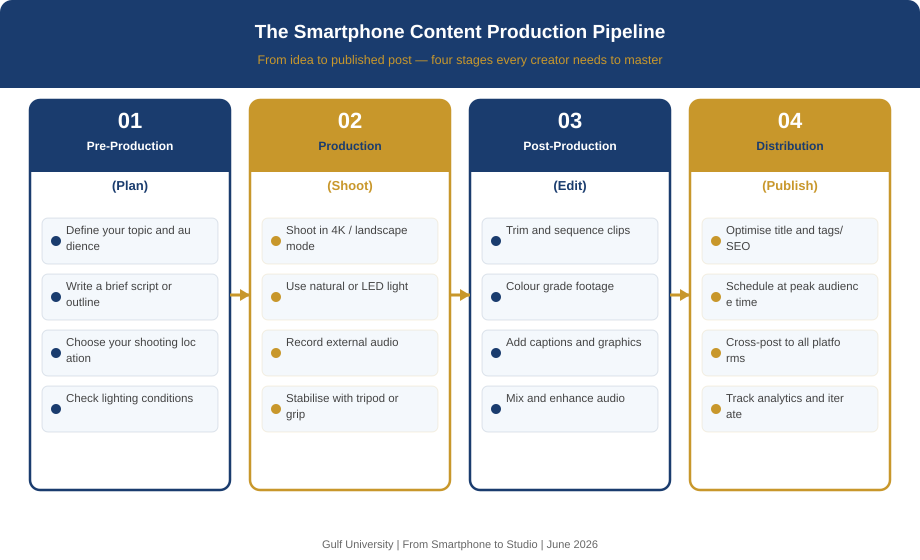
Underinvestment is the common trait of the pre-production stage. The choice of an appropriate subject, target audience, creation of an outline and location scouting all take less than half an hour in total and significantly reduce the chances of shooting wasted and requiring retakes. Batching of material, filming several items in one go in the same setting, increases the efficiency even further.
When it comes to the distribution stage, timing of publication and metadata optimization matter just as much as the content itself. Publications timed right and containing well-worded keyword-rich descriptions and cross-posted on other networks can provide reach two to five times bigger than unoptimized publications do.
Content creation economy has transitioned from being on the fringes to forming a profession that is now mainstream. There are over 200 million people around the world who consider themselves content creators, and 42% of them work at this job full-time. Furthermore, 63% of part-time creators plan to move to full-time positions within the next two or three years.
In Bahrain and other Gulf nations, the need for talented digital content professionals is growing quickly due to Vision 2030 projects, the expansion of the e-commerce sector, and the realization by firms that digital content performs better than traditional ads. No matter what type of career one is planning to pursue — whether it is marketing, journalism, public health communications, or entrepreneurship — being able to create professional digital content is no longer a specialization but an essential skill.
Gulf University students have unique opportunities to develop these competencies: cultural stories around, young and digital generation, and a digitalizing economy in the region. The only issue here is not the necessity of developing such skills but the speed of doing it.
The most common mistake that new aspiring creators make is postponing the actions until getting better equipment. Start working on yourself with what you have right now. Here are the practical steps for the first month of work:
Practice makes compound results. There is no connection between becoming a professionally working creator within a year and having natural talent; the more successful ones start doing things earlier, regularly publish their content pieces and learn from each of them.
There is hardly any difference now between the potential of a mobile phone and studio production. If there are adequate skills in lighting, audio, framing, editing, and workflow, a mobile phone can create such output that is comparable to the content created in professional production studios. Barriers to digital content creation professionally have been reduced significantly. Now what is left is the resolve to learn the trade carefully, to keep practicing and sharing one’s point of view with the rest of the world. At Gulf University, we believe that learning this skill set is one of the best things a person can do in this digital age.
Dr. Sherif Badran
Gulf University, Bahrain
Last Updated: 07 Jul 2026