
Engineering
Departments
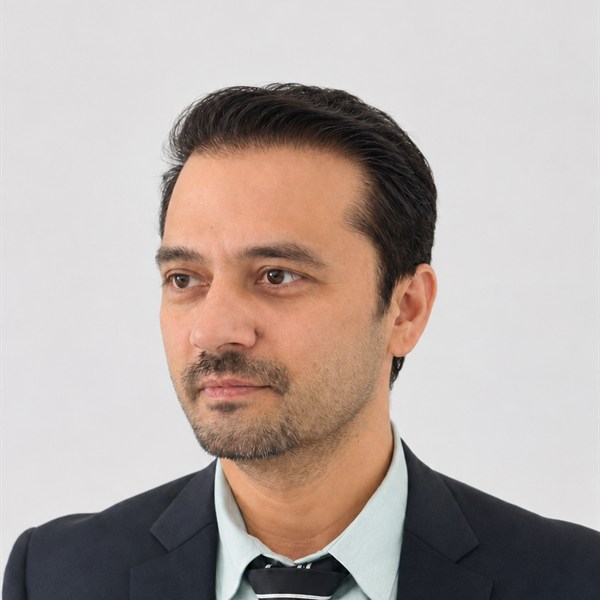
Dr. Fawad Ali
Current Position: Assistant Professor
Email: dr.fawad.shah@gulfuniversity.edu.bh
Title: Assistant Professor
College: Engineering
Department: Mechanical Engineering
Google Scholar:View profile (h-index 16, 1,197 citations)
Qualification
- Ph.D. in Mechanical Engineering, Queensland University of Technology, Australia, 2019 — Australian Postgraduate Research Award / Merit Scholarship
- M.S. in Engineering, Sunchon National University, South Korea, 2012 — Korean Government Scholarship, with Distinction
- B.S. in Materials Science and Engineering, Ghulam Ishaq Khan Institute of Engineering Sciences and Technology, Pakistan, 2010
Teaching & Learning Statement
Dr. Fawad has taught a broad range of mechanical and materials engineering courses at undergraduate and postgraduate levels, with experience in laboratory instruction, outcome-based education (OBE) curriculum development, program accreditation and student mentorship. At Gulf University he teaches Engineering Materials, Applied Engineering Design, Engineering Drawing, Engineering Design and Materials in Design, and supervises final-year capstone projects. He completed Evidence-Based Teaching (CITRL, Texas A&M University) with Distinction and applies research-informed instructional methods to strengthen the learning experience of his students.
- Engineering Materials and Materials Selection
- Manufacturing Processes & Advanced Manufacturing
- Materials in Design
- Polymer Science & Composites
- Engineering Design
- Materials Selection for Mechanical Systems
- Research Methodology
- Capstone Design & Project Supervision
Experience
Dr. Fawad is an Assistant Professor in the Department of Mechanical Engineering at Gulf University, where he teaches, supports curriculum development and program accreditation (including OBE lab assessment aligned with the Washington Accord and preparation of the Self-Assessment Report), and engages with industry stakeholders. He brings over 10 years of research and teaching experience. Before joining Gulf University, he held postdoctoral positions at Hamad Bin Khalifa University (Qatar), working on additive manufacturing of smart materials and of magnesium-based implants for biomedical applications; at Texas A&M University, on 3D printing of piezoelectric materials for energy harvesting; at the Qatar Environment and Energy Research Institute, on high-efficiency, low-cost perovskite solar cells; and at Queensland University of Technology, on perovskite solar cell device fabrication. He has also served as an Assistant Professor at the University of Applied Sciences and Technology and at the US-Pakistan Center for Advanced Studies in Energy (UET Peshawar), where he designed materials engineering curricula and established characterization laboratories, and as a Lecturer and Project Coordinator in Mechanical Engineering at Sarhad University of Science and IT.
Research Interest
Dr. Fawad’s research centres on materials, manufacturing and their applications, with a particular focus on additive manufacturing (3D and 4D printing) of smart materials. His work covers the synthesis and characterization of advanced materials for energy harvesting, including piezoelectric and thermoelectric materials and nanogenerators; thin-film deposition and characterization; perovskite solar cells; and 3D-printed polymer and magnesium composites for biomedical applications such as bone tissue scaffolds. He has published over 25 journal articles in highly reputed scientific journals, along with numerous conference papers, and his work was featured on the front cover of ChemSusChem (2018).
Selected Publications
- Fawad Ali, Imran Pervez and Mohammad Albakri. (2025). “Tailoring Piezoelectric Properties in PVDF Filaments: A Focus on Feedstock Processing and its Influence on β-Phase in PVDF Filaments”. Smart Materials and Structures.
- Fawad Ali, Sumama N. Kalva and Muammer Koc. (2024). “Advancements in 3D printing techniques for biomedical applications: a comprehensive review of materials consideration, post processing, applications, and challenges”. DOI: 10.1007/s43939-024-00115-4.
- Fawad Ali, Sumama N. Kalva and Muammer Koc. (2023). “Mg-doped PLA composite as a potential material for bone tissue regeneration – synthesis, characterization and additive manufacturing”. Materials, 16(19), 6506. (Impact Factor: 3.78).
- Fawad Ali and Muammer Koc. (2023). “3D Printed Polymer Piezoelectric Materials: Transforming Healthcare through Biomedical Applications”. Polymers. (Impact Factor: 5.0).
- Fawad Ali, Sumama N. Kalva and Muammer Koc. (2022). “Additive Manufacturing of Polymer/Mg-Based Porous Bone Tissue Scaffolds”. Polymers, 14. (Impact Factor: 5.0).
- Fawad Ali, Cristina Roldán-Carmona, Muhammad Sohail and M. K. Nazeeruddin. (2020). “Application of Self-Assembled Monolayers for Perovskite Solar Cells Interface Engineering to Address the Stability and Efficiency Issues”. Advanced Energy Materials, 2002989. (Impact Factor: 29.69).
- Fawad Ali, Ngoc Duy Pham, Ken Ostrikov, John M. Bell, Hongxia Wang and Tuquabo Tesfamichael. (2019). “Low Hysteresis Perovskite Solar Cells Using Electron-Beam Evaporated WO3−x Thin Film as Electron Transporting Layer”. ACS Applied Energy Materials, 2, 5456–5464. (Impact Factor: 6.95).
- Fawad Ali, N. D. Pham, H. Jonathan Bradford, N. Khoshsirat, K. Ostrikov, J. M. Bell, H. Wang and T. Tesfamichael. (2018). “Tuning the Amount of Oxygen Vacancy in Sputter-Deposited SnOx Films for Enhancing the Performance of Perovskite Solar Cells”. ChemSusChem, 11, 1–9. (Impact Factor: 9.14).
- Tengfei Qiu, Bin Luo, Fawad Ali, Esa Jaatinen, Lianzhou Wang and Hongxia Wang. (2016). “Metallic Nanomesh with Disordered Dual-Size Apertures as Wide-Viewing-Angle Transparent Conductive Electrode”. ACS Applied Materials & Interfaces, 8, 22768–22773. (Impact Factor: 10.38).
Awards & Achievements
- HDR Higher Achiever Award, Queensland University of Technology (2018)
- Front Cover Page, ChemSusChem (2018)
- QUT Postgraduate Research Award (QUTPRA) and Higher Degree Research Tuition Fee Sponsorship (2015)
- Korean Government Scholarship for Master’s studies (2010)
Last Updated: 10 Nov 2026