May 26, 2025
Transforming Design Education: How AI is Shaping the Future of Creativity and Learning
Dr. Aseel Abdulsalam Al Ayash

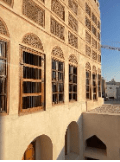
The Pearling Path trail stands as a testament to the Kingdom of Bahrain’s millennium-old pearl-collecting history. “Pearling, Testimony of an Island Economy” was designated as the country’s second World Heritage Site in 2012.
The regional influences from East Africa, Iraq, the Arabian Peninsula, India, and Persia are seamlessly blended with the regionally influenced styles. Persia is represented in the woodwork of the ceilings and decorative panels; while windows, doors, and their frames were imported via Indian trade routes. Additionally, Arabic culture served as the inspiration for artistic patterns.
Located at the southernmost point of Muharraq, Bu Mahir’s Seashore once stood as a tidal island. It remains the only authentic seashore where celebrations marking the pearling season were held, largely unchanged since the collapse of the pearling economy in the 1930s. Many pearl divers used Bu Mahir Seashore, a sandy point that protrudes into Bahrain’s main harbor, as their last firm surface before starting the main pearling season and as their first landing spot after several months at sea.
Since the establishment of the Bu Mahir Visitor’s Centre in 2014, the public can once again access Bu Mahir’s Seashore via a water taxi, which connects the center to the Bahrain National Museum.
Qal’at Bu Maher was originally a four-towered fort with massive defensive walls. Its defensive range covered the narrow channel south-east of Muharraq town, Arad and the passage to Manama.
The Pearling Path Visitor & Experience Centre is located in the heart of Muharraq, amidst the historic Amarat of the traditional market. Designed by Valerio Olgiati Architects, the project incorporates Amarat Al Doy and its subsequent extension, alongside the remains of Amarat Yousif A. Fakhro, a historic Amarat building constructed in the 1930s.
The center serves as a community hub, featuring exhibition spaces, areas for children and workshops, the Pearling Heritage Archive, a library, and conference facilities. The restoration of 15 wind towers enhances the climate beneath the roof.
A historic market that served as a port for product exchange during the pearling era, with cafes where pearl trade took place.
In the absence of modern medical services, this house served as a small health clinic for pearl divers with lung, eye and skin diseases.
A breathtaking example of traditional architecture with Mashrabeya, arches, courtyards, and detailed interiors for gatherings and meetings.
Built to withstand extreme climate using gypsum-covered coral walls and bamboo ceilings, with built-in wall voids for cool air circulation.
The 3.5-kilometer route serves as a link between the Pearling Path’s numerous urban sections and shapes the Pearling Testimony’s narrative, in which each house stands for a different chapter. The public areas function as meeting locations for locals and tourists, providing opportunities for relaxation, recreation, and social contact. Several urban elements found during the walk include signages, urban furniture, and trees that create a microclimate and offer shade. Every public area is tailored to its specific setting and features various activities including playgrounds, stairs, and kiosks.
Christian Kerez planned and built four multistory parking structures in Muharraq. They benefit the community by giving residents free parking spots and charging visitors for parking. Their wide-open buildings provide a fresh urban appeal and give the old city center new characteristics. Every level of the new parking structures offers a unique spatial experience. From above and below, the parking seems like a stack of landscapes.
Al Ghus House, Al Jalahma House, Murad House, Al Alawi House, Fakhroo House, ‘Amārat Yousif A. Fakhro, ‘Amārat Ali Rashed Fakhro I, and Nūkhidhah House are also significant landmarks within the Pearling Path Trail. The pearling path trail stands as a testament of Bahrain’s Legacy, Urban Design, Cultural Exchange and a blend of Architectural Styles of different regions.
Ms. Sandra Job
Gulf University
Last Updated: 09 Apr 2026