
The Classroom Without Walls: Is Learning Anywhere Becoming the New Normal?
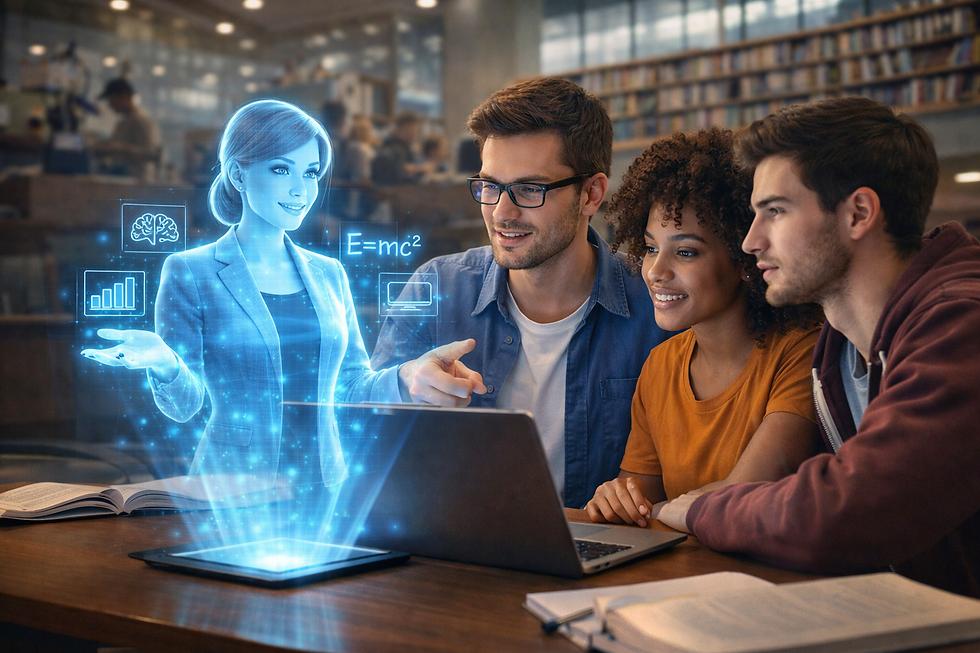
Discover how hybrid learning, AI tutors, virtual laboratories, MOOCs, and digital campuses are transforming higher education, creating classrooms without walls and redefining the future of learning.
When Does a Classroom Stop Being a Classroom?
For centuries, education has been associated with a familiar image: a lecturer standing before students in a classroom, sharing knowledge within four physical walls. While this traditional model has shaped generations of learners, the rapid advancement of digital technology is challenging one of higher education’s oldest assumptions—that learning must happen in a specific place.
Today, a student can attend a lecture from another continent, complete a laboratory experiment through simulation software, collaborate with peers across multiple time zones, and receive personalized academic support from an Artificial Intelligence (AI) tutor—all without stepping into a conventional classroom.
This transformation raises an important question:
Has the classroom evolved beyond its walls, making learning possible anytime, anywhere?
Rather than replacing universities, this shift is redefining their role. Higher education is moving toward a model where physical and digital learning environments complement one another, creating richer, more flexible educational experiences.
Hybrid Learning: Blending the Best of Both Worlds
One of the most significant developments in modern higher education has been the adoption of hybrid learning. By combining face-to-face teaching with digital learning experiences, universities are creating environments that offer both flexibility and meaningful academic engagement.
Students are no longer limited to scheduled classroom sessions. Recorded lectures, interactive online discussions, collaborative digital platforms, and virtual office hours allow learning to continue beyond campus and beyond traditional timetables.
Importantly, hybrid learning should not be viewed as simply moving lectures online. Instead, it represents a strategic shift toward student-centered education, where technology supports different learning styles while preserving the value of direct interaction between educators and students.
For universities, the goal is not to replace traditional teaching but to enrich it by providing students with greater accessibility, flexibility, and ownership of their learning journey.
Virtual Laboratories: Expanding Practical Learning
Practical experience remains fundamental in engineering, science, healthcare, and technology education. However, access to laboratory facilities has traditionally been limited by time, equipment availability, and physical resources.
Virtual laboratories are transforming this experience.
Through advanced simulations, digital twins, and immersive technologies, students can conduct experiments, explore engineering designs, and test complex systems in realistic virtual environments. These tools allow learners to repeat procedures, analyse different scenarios, and strengthen conceptual understanding before entering physical laboratories.
Rather than replacing hands-on experiences, virtual laboratories enhance them. They enable students to build confidence, improve technical competence, and maximize the value of practical sessions by arriving better prepared.
As simulation technologies continue to evolve, they are becoming an indispensable component of modern engineering and scientific education.
MOOCs: Learning Beyond Institutional Boundaries
Massive Open Online Courses (MOOCs) have fundamentally changed access to knowledge.
Students can now explore specialised subjects offered by leading universities across the world, gaining exposure to emerging technologies, interdisciplinary topics, and professional skills that extend beyond their formal curriculum.
More importantly, MOOCs reinforce an increasingly important concept in higher education: learning should not end with graduation.
In an era where industries continue to evolve rapidly, graduates must continually update their knowledge and acquire new competencies throughout their careers. Universities are therefore preparing students not only for their first job but for a lifetime of continuous learning.
Artificial Intelligence: The New Learning Companion
Artificial Intelligence is rapidly becoming one of the most influential technologies in higher education.
AI-powered tutors can provide immediate feedback, recommend personalised learning resources, identify knowledge gaps, and answer routine academic questions at any time of the day. This creates a more adaptive learning experience where students receive support whenever they need it.
However, while AI significantly enhances access to knowledge, it cannot replace the uniquely human aspects of education.
Inspiration, mentorship, ethical guidance, creativity, and meaningful academic discussions remain the responsibility of educators. Technology can personalise learning, but it cannot replicate the experience, wisdom, and human connection that define exceptional teaching.
The future of higher education therefore lies not in choosing between AI and educators, but in creating productive partnerships between both.
The Emergence of the Digital Campus
Perhaps the most significant transformation is the emergence of the digital campus.
Today’s universities are no longer defined solely by lecture halls, libraries, or laboratories. Digital ecosystems now connect students, educators, researchers, and learning resources regardless of geographical location.
Academic advising, research collaboration, digital libraries, online seminars, and international teamwork have become integral components of university life. These developments are making education more accessible while encouraging collaboration across cultures, disciplines, and borders.
The digital campus does not diminish the importance of physical universities. Instead, it extends their reach, allowing institutions to create learning experiences that are more flexible, inclusive, and globally connected.
Redefining the Purpose of the University
As learning becomes increasingly borderless, universities are experiencing a fundamental shift in purpose.
The institution of the future will no longer be valued simply as a place where information is delivered. Information is already available instantly through countless digital platforms. Instead, universities will be recognised for developing critical thinkers, ethical professionals, innovative researchers, and lifelong learners capable of solving complex global challenges.
Technology expands access to knowledge, but universities remain essential because they provide something technology alone cannot—intellectual mentorship, collaborative discovery, academic integrity, and communities that inspire innovation.
The classroom may be changing, but the mission of higher education remains constant: to empower individuals with the knowledge, skills, and values needed to shape society.
Conclusion
The classroom is no longer a place—it is becoming an experience.
As Artificial Intelligence, hybrid learning, virtual laboratories, and digital campuses redefine higher education, universities stand at the threshold of a remarkable transformation. The question is no longer whether learning can happen beyond the classroom; it is whether institutions are ready to unlock its full potential.
The universities that lead the future will not be remembered for the walls they built, but for the boundaries they removed. Because when learning is no longer confined by space or time, education becomes truly limitless.
Ms. Ameera Hydrose
Gulf University
Last Updated: 12 Jul 2026