April 21, 2026
Artificial Intelligence Has Not Changed Education Yet… But It Has Changed the Exam
Prof. Firas Mohammed

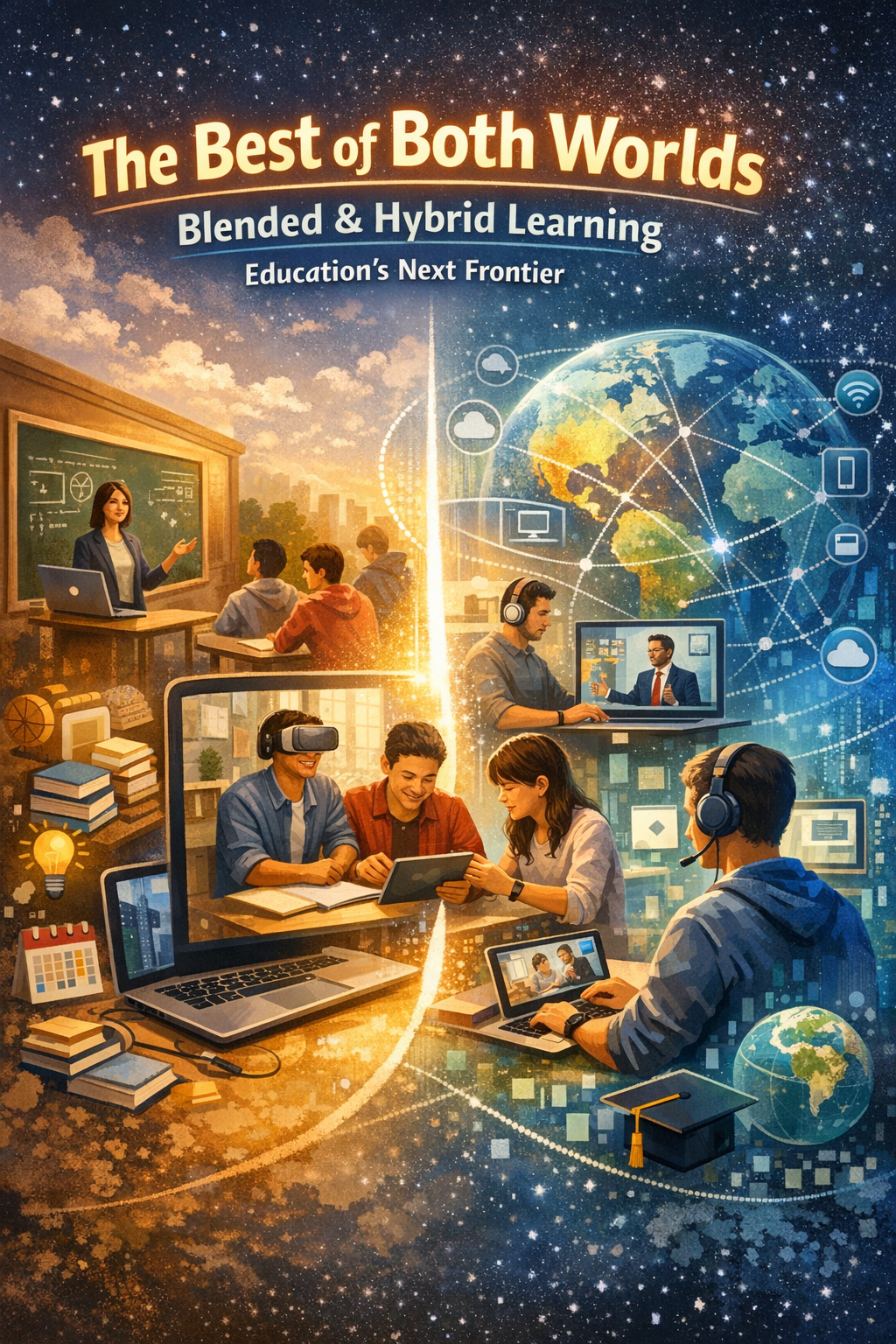
Schooling was once just a room, a teacher, and some students. Then came e-learning — efficient, but missing the spark of real-life learning. Blended and hybrid models refuse to choose sides, combining the best of both worlds into something fresh, flexible, and human. Explore why they are fast becoming education’s next frontier.
Schooling has traditionally been about three things: a room, a teacher, and some students. Then came the digital revolution with e-learning and the promise of learning at one’s own pace. However, with the rise of e-learning, something was lacking—the spark of real-life learning. Enter two new forms of learning that won’t choose sides. Instead, they combine the best of both worlds to bring something fresh, adaptable, and interesting. So, what exactly are they, and why are they becoming the new normal?
While both terms are often used interchangeably, there is a difference between the two. One is more about the method of teaching, while the other is more about the method of delivery.
Blended Learning is a method of teaching that combines online learning with offline learning. One example is the use of the ‘flipped classroom’ method. Here, the teacher lectures online at home, and when the student comes to class, they get to participate in group work and problem-solving. The online lecture is used to supplement the offline class.
Hybrid Learning, on the other hand, is more about the method of delivery. Here, the student is given the choice to participate in the class either online or offline. The idea is to provide the student with the same experience, whether they are in the class or at home.
Blended and hybrid models are not a passing phase, but rather an answer to the changing needs and wants of the modern learner. So, why are blended and hybrid models an effective solution? The answer is as follows:
Technology allows for adaptive learning. Online platforms can track the learner, identify gaps, and provide the learner with the appropriate resources, thus freeing the teacher to provide individualized attention to the learner where they need it most.
The world is full of unexpected twists and turns, and blended and hybrid models provide the learner with the flexibility to choose the modality they need most, whether it is an online course, an in-person course, or a mix of the two, depending on their health, location, and other factors.
By moving the lecture online, the face-to-face time can be spent on more collaborative and engaging activities, thus creating a deeper and richer learning experience.
Both blended and hybrid models are ideal for the development of 21st-century skills, as the learner must learn to use the online platforms, as well as effectively use their own time and collaborate with other learners.
The debate is over, and the answer is not “online” or “in-person,” but rather “how can we integrate the two.” The answer is blended and hybrid models, as they are the sustainable, effective, and humanistic solution to the future of education.
By embracing the synergy between the two, educational institutions can develop an education system that is more sustainable, equitable, and effective, thus better preparing the learner for the complexities that the future holds.
Prof. Firas Mohammed
Dean of College of Law, Gulf University
Last Updated: 08 Jun 2026