May 30, 2026
Electrical Engineering in the Age of Artificial Intelligence
Ms. Ambi Rachel

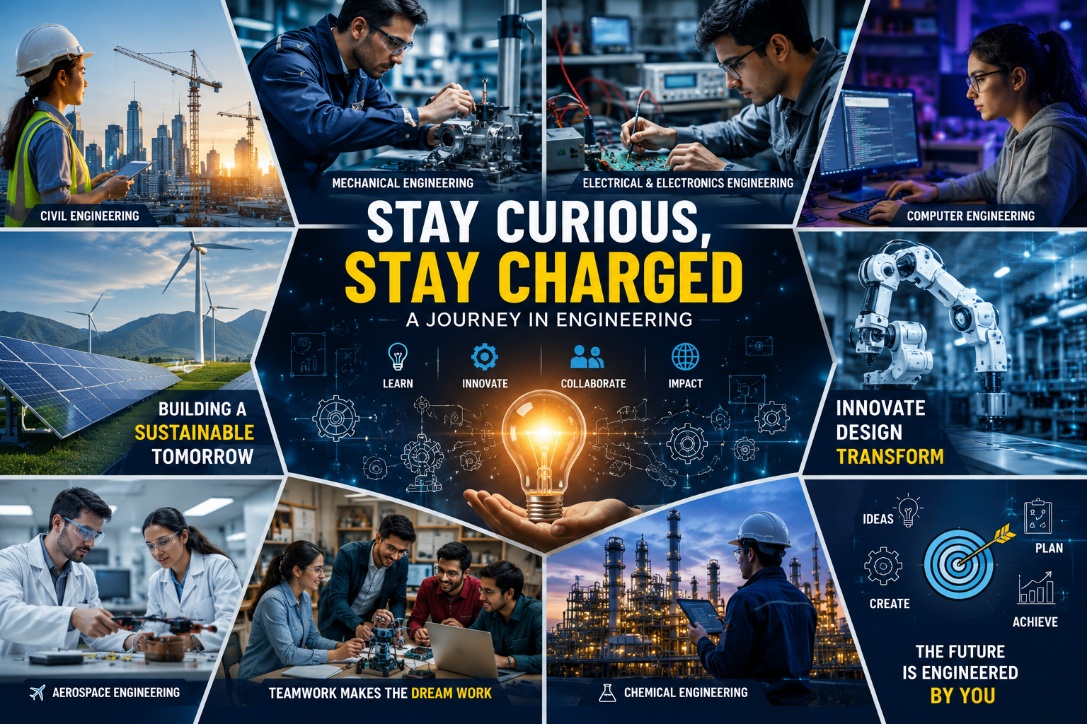
Explore how curiosity, continuous learning, and resilience shape successful engineers across all disciplines. An inspiring perspective on engineering education, innovation, and professional growth.
What truly defines a great engineer? Is it technical expertise, academic excellence, or years of experience? While these elements are important, one quality consistently stands out across all engineering disciplines—curiosity.
Whether in civil, mechanical, electrical, or computer engineering, every breakthrough begins with a simple question: “Why?” or “What if?” Curiosity is the force that transforms theoretical knowledge into practical innovation. It is the spark that drives engineers to challenge existing systems, explore new ideas, and create meaningful solutions.
As an educator, I have observed that students who cultivate curiosity often outperform expectations—not necessarily because they know more, but because they are willing to learn more. Engineering is not just about solving known problems; it is about discovering new possibilities. This mindset is what sets apart those who simply complete tasks from those who truly innovate.
Engineering is not built on memorization—it is built on understanding, exploration, and application. A curious engineer does not stop at the first answer; instead, they seek deeper insights into how systems function and how they can be improved.
Curiosity encourages engineers to question assumptions and explore multiple approaches to a problem. For example, when faced with a design challenge, a curious student might ask: Is there a more efficient solution? Can this be optimized? What are the limitations? These questions lead to stronger analytical thinking and better problem-solving skills.
Without curiosity, engineering becomes repetitive and mechanical. With curiosity, it becomes a dynamic process of innovation. It is this mindset that drives technological advancement and shapes the future of industries worldwide.
The engineering landscape is evolving faster than ever before. Advancements in artificial intelligence, renewable energy, automation, and smart technologies are transforming the way we live and work. In such a dynamic environment, engineers must remain “charged”—continuously updated, adaptable, and ready to learn.
Being “charged” goes beyond acquiring knowledge; it involves maintaining a proactive attitude toward professional growth. Engineers must actively seek opportunities to expand their skills, whether through research, projects, or collaboration across disciplines.
Lifelong learning is no longer optional in engineering—it is essential. The knowledge gained during a degree program provides a foundation, but real growth occurs when engineers continue to build upon that foundation throughout their careers. Those who remain curious and committed to learning are better equipped to navigate change and lead innovation.
Engineering education plays a critical role in developing the mindset and skills required for success. Educators are not just responsible for delivering content; they are responsible for inspiring curiosity and fostering independent thinking.
An effective engineering classroom goes beyond lectures and textbooks. It encourages students to experiment, explore, and engage with real-world problems. When students are given the freedom to question and the confidence to fail, they develop resilience and creativity.
Educators must also bridge the gap between theory and practice. By connecting academic concepts to real-world applications, students gain a deeper understanding of how their knowledge can be used to solve practical challenges. This approach not only enhances learning but also prepares students for the complexities of professional engineering environments.
Every engineering journey includes challenges. Designs may fail, experiments may not yield expected results, and projects often require multiple iterations. While these experiences can be frustrating, they are essential for growth.
Challenges teach engineers how to think critically, adapt to changing conditions, and persist in the face of difficulty. They encourage problem-solving under constraints and promote innovation through necessity.
Failure, in this context, is not an endpoint—it is a stepping stone. Each failed attempt provides valuable insights that bring engineers closer to a successful solution. Those who embrace challenges as learning opportunities develop stronger technical skills and greater confidence in their abilities.
Engineering is not just about systems, machines, or structures—it is about impact. Engineers play a crucial role in addressing global challenges such as climate change, sustainable development, healthcare advancements, and technological accessibility.
From designing energy-efficient systems to developing smart infrastructure, engineers contribute to building a better future. Understanding the broader impact of engineering work gives students a sense of purpose and motivation. It reminds them that their efforts extend beyond the classroom and have the potential to improve lives.
When engineers align their skills with meaningful goals, their work becomes more than a profession—it becomes a mission.
The journey of engineering is not defined by how much knowledge one possesses, but by the willingness to learn, adapt, and grow. Curiosity is the starting point, but it must be supported by passion, persistence, and continuous effort.
In a world that is constantly evolving, engineers must remain active learners and critical thinkers. They must be willing to question existing systems, explore new ideas, and embrace challenges as opportunities for growth.
Stay curious when faced with uncertainty. Stay charged when progress feels slow. And never stop learning, building, and innovating.
Because the engineers who shape the future are not those who know everything—but those who never stop asking, never stop exploring, and never stop creating.
Ms. Ambi Rachel
Gulf University
Last Updated: 08 Jun 2026