May 26, 2025
Transforming Design Education: How AI is Shaping the Future of Creativity and Learning
Dr. Aseel Abdulsalam Al Ayash

Interior design is an industry that has largely depended on creativity and instinct but has taken a technological twist. The advancement of Artificial Intelligence has affected how interiors are designed as it is smarter, more efficient and even more personalized.
Regarding ingenious interiors, AI is reshaping how we engage interiors across utilization and design by automating various general tasks. This synergy in technology and design is the beginning of a new epoch in designing beautiful, constructive and harmonious spaces.
AI has greatly helped in bringing about a new meaning to personalized interior design because of personalized spaces for people. Because the performances of these tools are based on the observations of users’ behavior, their preferred styles, and lifestyle patterns, the produced design solutions look as if they were developed specifically for a particular user. For instance, it can build a 3D room model from basic inputs such as size, and then propose incredibly accurate furniture choices, room arrangement, and color scheme.
Supporting this is AI-assisted visualization which helps create the connection between the idea and a real-world application. AR/VR lets the clients walk through the rooms they’re designing or redecorating, moving furniture, choosing colors, or testing lighting without changing a thing in reality. Besides improving the quality of decisions made, this approach would definitely ensure more satisfying results as per clients’ needs.
AI analyzes users’ behavior, preferred styles, and lifestyle patterns to produce tailored design solutions for each individual.
Clients can walk through rooms, move furniture, choose colors, and test lighting without changing anything in reality.
AI suggests eco-friendly materials, natural lighting optimization, and waste minimization for environmentally conscious interiors.
From adaptive lighting to temperature systems that adjust by occupancy, AI makes spaces smarter and more energy efficient.
AI has perhaps one of the most potential and direct impacts on interior design through enhancing workflow. Such processes that were previously all manual for drafting layouts, trying to optimize furniture layout, and choosing compatible materials for use in the house are now able to be completed with unerring accuracy. This ensures that time is saved, and errors in costs are subdued, allowing designers to work more on their creative work.
AI also helps in following sustainable design by suggesting environmentally friendly materials, means of getting natural light to minimize energy use and ways of minimizing wastes. For instance, AI can take a glance at a space and recommend optimal arrangement of furniture to minimize energy consumption by allowing natural light. When sustainability becomes a core component of design, AI maintains that contemporary interiors are as sustainable as they are stylish.
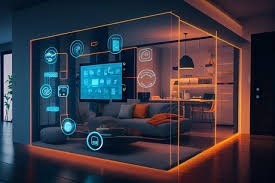
AI is not used for visual elements only but also combines functionality into interior design via smart home technology. Anything from lighting systems that dim or brighten in response to natural available light to temperature systems that adjust depending on the people who are present in a particular area makes a space smarter by applying artificial intelligence.
A smart living room means blinds would be pulled down and lights would turn off during movies and regulate the temperature according to the weather outside. Such features not only improve the use but also the efficiency of the resource to fulfil the purpose of smart spaces — being both functional and environmentally efficient.
AI does not act as a competitor to human designers and rather works as more of a teammate. While AI has the integrated capability of data analysis and providing practical solutions, human designers have the element of emotional quotient, aesthetic sense, and creativity with them. Combined they craft interiors that are as efficient as they are aesthetically beautiful and make the design experience richer. This partnership enables designers to shift the focus on to what is creative, giving artificial intelligence the responsibility of the technical side of designs.
Interior design is therefore being categorically transformed by artificial intelligence in ways that see the kind of intelligent spaces created, being personalized, sustainable and efficient. Due to the integration of technology into the design process, AI guarantees that the interiors of the contemporary environment are not only useful but also stunning. AI has slowly crept into the furniture industry and it gets even more exciting as the technology progresses as we experience adaptive design that changes depending on the mood of users and robotic furniture assembly.
It is time for AI in the design of interior spaces as well as in the way we occupy these spaces. An opportunity to plunge into the era of smart interiors: innovation is not an invention.
Dr. Aseel Abdulsalam Al Ayash
Assistant Professor & Dean of the College of Engineering, Gulf University
Last Updated: 09 Apr 2026