
April 4, 2026
AI is Rewriting the Rules: How Smart Universities Are Winning the Future of Digital Public Relations
Mr. Ammar Mohamed

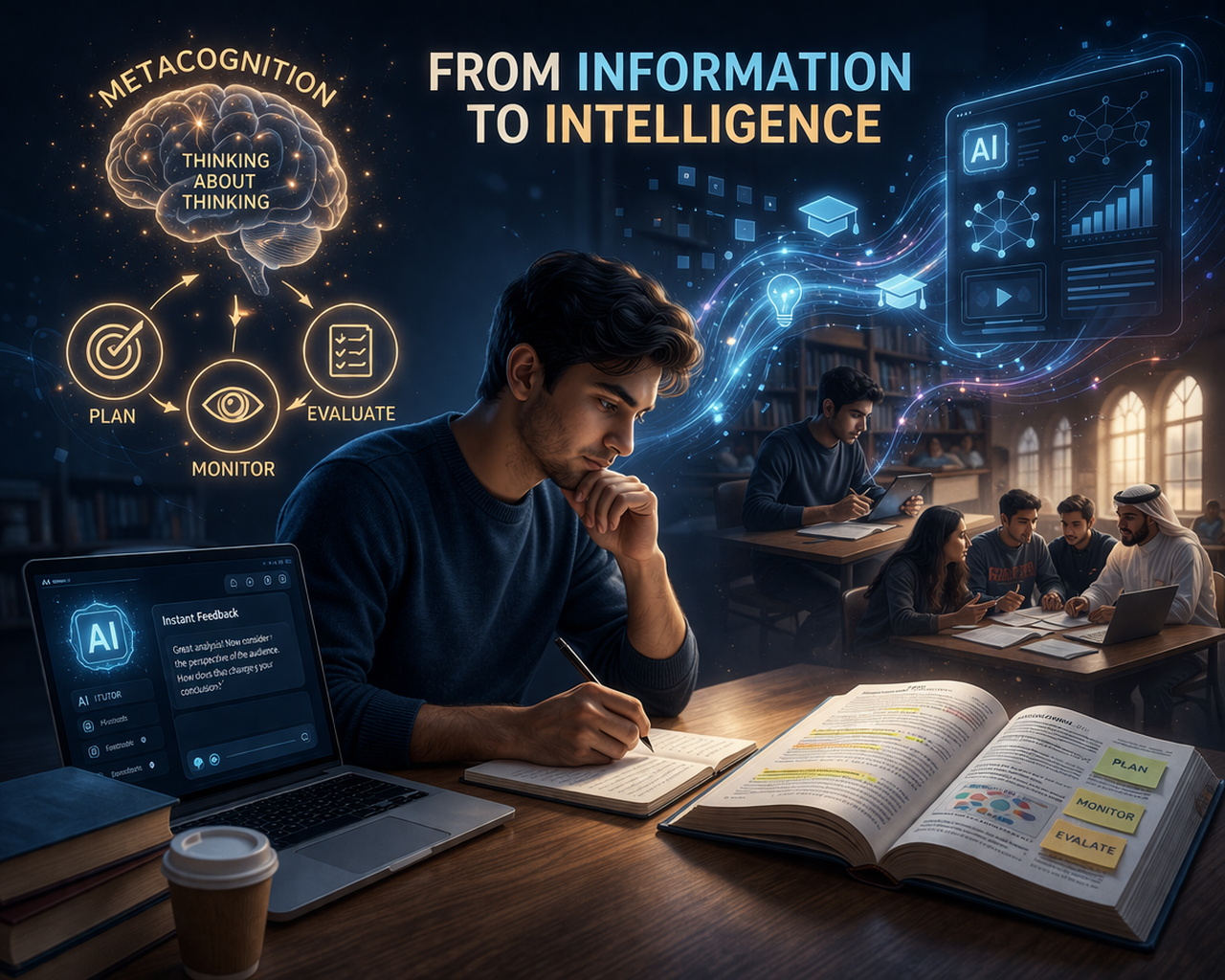
Explore how metacognitive learning combined with AI is transforming higher education and empowering students with critical thinking and self-regulated learning skills.
In the modern digital landscape, students have reached a point of “information saturation.” With a few keystrokes, they have unlimited access to the sum of human knowledge. However, this accessibility introduces a profound pedagogical dilemma: Are students truly thinking, or are they merely consuming?
In the age of Generative AI, the primary challenge in higher education is no longer the acquisition of data, but the capacity to synthesize, analyze, and apply that data with intent. This is where Metacognition—the practice of “thinking about thinking”—becomes the ultimate differentiator.
Setting goals, selecting appropriate strategies, and allocating time effectively before diving into a task.
Checking in during the process to ask, “Do I actually understand this concept, or am I just recognizing the words?”
Reflecting on results to determine what worked, what didn’t, and how to improve the approach next time.
Students who possess strong metacognitive skills do not just study harder; they study smarter. They adapt to new challenges with agility and perform more effectively under pressure because they understand the mechanics of their own minds.
The integration of AI tools offers incredible opportunities for efficiency. However, these tools bring about what experts call the “AI Paradox.” While AI can lower the barrier to entry for complex topics, there is a hidden danger: Cognitive Laziness. When an answer is delivered instantly by an algorithm, the brain’s “struggle”—which is necessary for long-term memory and deep understanding—is bypassed. If students rely on AI as a mental crutch rather than a mental catalyst, they risk developing a superficial understanding that lacks the nuance of critical thought.
AI generates personalized quizzes targeting specific weaknesses, forcing students to confront what they don’t know.
Students receive immediate corrections, allowing them to adjust their mental models in real-time.
AI suggests specific resources based on learning style, encouraging ownership of the curriculum.
In this framework, the student remains the active pilot, while AI serves as the sophisticated navigation system.
Requiring students to document their thought processes—turning the “process” into the “product.”
Using AI to provide granular, formative feedback that fosters a “growth mindset.”
Teaching students to treat AI outputs as a “first draft” requiring human scrutiny and ethical evaluation.
The future of work and education is not a binary choice between “Human” and “Machine.” We are moving toward a state of Hybrid Intelligence. Humans provide the creative spark, ethical judgment, emotional intelligence, and strategic vision. AI provides the processing power, speed, data analysis, and pattern recognition. The graduates who will lead their industries are those who can navigate this relationship.
In a world overflowing with automated information, true intelligence is no longer measured by how much you know, but by your level of self-awareness. The students who understand how they think are the ones who will ultimately lead the future.
Mr. Ammar Mohamed
Gulf University
Last Updated: 29 Jun 2026
