
November 14, 2024
Building Bonds: Creating a Supportive and Collaborative Classroom for Student Success
Ms. Ambi Alex

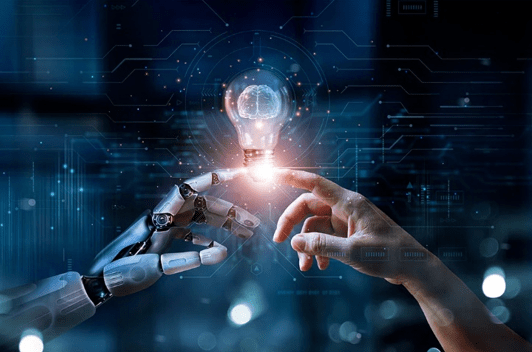
In the future of work, humans and AI will collaborate in a way that maximizes their complementarities rather than replacing humans with AI. From digital assistants and online shopping to sophisticated medical diagnostics and workplace automation, artificial intelligence is rapidly changing many aspects of modern life.
Whereas by 2030, integration of AI will be much more pervasive in an exciting and challenging style, impacted virtually on all aspects of civilization. This article looks at how AI might influence work, healthcare, education, and ethical dilemmas by the year 2030.
“The future of work will not just be about AI replacing jobs but about humans and AI collaborating in new, innovative ways.”
This implies that in order to educate workers for occupations that use AI, new skills will be needed, leading to a change in education and training. The pivotal question now becomes: “How can we prepare the next generation with the skill sets they will need to work effectively with the AI systems?”
Artificial intelligence will augment, not replace, human intelligence. Combining AI’s capability to process large volumes of information with human imagination and intuition will drive innovation on new levels.
Humans and AI will collaborate, combining AI’s data processing with human creativity and intuition to drive innovation.
AI will serve as the “stethoscope of the 21st century,” helping predict and prevent diseases before symptoms appear.
AI systems must be based on ethical and diverse data sets to prevent reiterating preexisting biases.
Fei-Fei Li, co-director of Stanford’s Human-Centered AI Institute, reminds us that “With great power comes great responsibility.” AI can only be as objective as the data it uses to train. To prevent reiterating preexisting biases, we must make sure that our AI systems are based on ethical and diverse data sets.
In three decades, beginning from the year 2030, AI will find applications in every medical process for assisting doctors and other related professionals in diagnosing and treating patients with more success. According to Eric Topol, a cardiologist and an expert in AI, “it constitutes the stethoscope of the 21st century.” Health professionals shall be able to predict diseases, and thus prevent them, even before the appearance of symptoms due to the investigative ability of AI in enormous databases.
“AI constitutes the stethoscope of the 21st century.”
The potential for groundbreaking changes that AI will bring into daily life as 2030 approaches: enormous and complex opportunities. While AI is promising much to industries such as healthcare, education, and the workplace, a number of key social and ethical issues arise. How well we begin to integrate AI now is the deciding factor in whether it propels progress or forces us to reassess some of our most deeply held beliefs. The decisions we make today will shape the future course taken by AI.
Ms. Ambi Alex
Gulf University
Last Updated: 09 Apr 2026
