
From Circuits to Cognition: How AI Is Rewriting the Future of Electrical Engineering Education
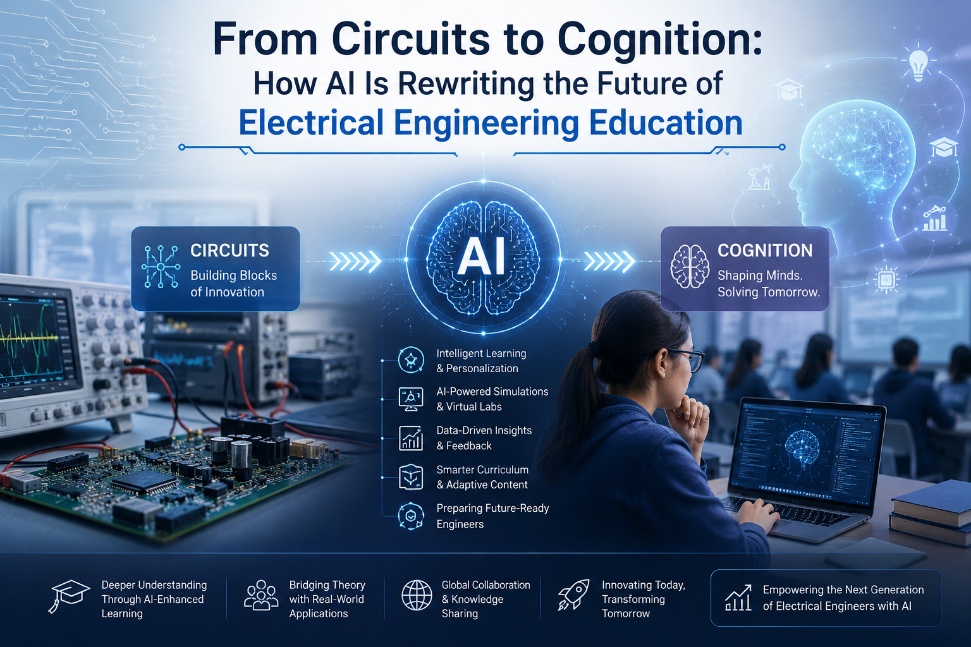
Discover how Artificial Intelligence is reshaping electrical engineering education by transforming traditional circuits-based learning into intelligent, data-driven, and future-ready engineering practice.
When Electrical Engineering Started Thinking for Itself
For decades, electrical engineering has been grounded in predictable laws—Ohm’s Law, Kirchhoff’s rules, electromagnetic theory, and circuit analysis. These principles form the backbone of modern infrastructure, from household wiring to national power grids.
But something fundamental is changing.
Electrical systems are no longer just being designed—they are beginning to adapt, learn, and optimize themselves. With the rise of Artificial Intelligence (AI), engineering systems are evolving from static configurations into dynamic, intelligent networks capable of decision-making in real time.
This shift raises an important question for higher education:
Are we still teaching electrical engineering as a system of fixed laws, or as a living, intelligent ecosystem?
The Shift from Deterministic Systems to Intelligent Systems
Traditional electrical engineering assumes that systems behave in predictable ways. Inputs produce known outputs, and engineers design accordingly.
However, modern infrastructure is increasingly unpredictable and complex due to:
- Renewable energy variability
- Distributed power generation
- Smart grid interconnectivity
- Electric vehicle integration
- Cyber-physical system dependencies
To manage this complexity, AI is now being embedded into electrical systems.
Machine learning algorithms can now:
- Forecast energy demand patterns
- Detect faults in milliseconds
- Optimize power distribution dynamically
- Predict equipment failure before breakdown
- Balance supply and demand in real time
In essence, electrical systems are transitioning from deterministic machines to cognitive systems.
AI as a New Layer in Electrical Engineering
Artificial Intelligence is not replacing electrical engineering—it is adding a new intellectual layer on top of it.
Where traditional engineering focuses on:
- Design
- Analysis
- Implementation
AI introduces:
- Prediction
- Optimization
- Adaptation
- Autonomous decision-making
This combination creates a new type of engineering system: the intelligent electrical system.
Examples include:
- Smart grids that self-heal after faults
- Renewable systems that adjust output based on weather prediction models
- Industrial plants that optimize energy consumption automatically
- Power systems that detect anomalies before humans intervene
These advancements are redefining what it means to be an electrical engineer.
Rebuilding Electrical Engineering Education for an AI Era
If engineering systems are evolving, education must evolve with them.
Traditional learning methods focused heavily on manual calculation, circuit solving, and theoretical modeling. While these foundations remain essential, they are no longer sufficient in isolation.
Modern electrical engineering education must now include:
- Data-driven system analysis
- AI and machine learning fundamentals
- Simulation-based design environments
- Real-time system monitoring tools
- Digital twin technologies
Students are increasingly required to think beyond equations and understand how data and intelligence influence system behavior.
This shift transforms students from passive learners into active system designers working with intelligent tools.
The Rise of Digital Twin Learning Environments
One of the most significant innovations in engineering education is the emergence of digital twins.
A digital twin is a virtual replica of a physical system that continuously updates using real-time data.
In electrical engineering education, this allows students to:
- Simulate power networks
- Test fault conditions safely
- Analyze system performance in real time
- Experiment with AI-based control strategies
Instead of learning only through textbooks, students now learn through living simulations of real-world systems.
This bridges the gap between theoretical knowledge and industrial application in a way traditional classrooms never could.
The Role of Educators in an Intelligent Engineering Era
As AI becomes more integrated into engineering systems, the role of educators becomes even more critical—not less.
Lecturers are no longer just transmitters of knowledge. They are becoming:
- Learning architects
- Innovation mentors
- System-thinking facilitators
- Guides in ethical engineering decisions
While AI can generate solutions, it cannot teach judgment, responsibility, or ethical reasoning in engineering design.
Students must learn not only how to build intelligent systems, but also how to ensure those systems are safe, ethical, and sustainable.
This is where human educators remain irreplaceable.
Preparing Engineers for Systems That Think
The future electrical engineer will not only design systems—they will design systems that think.
This requires a new mindset built on:
- Computational thinking
- AI literacy
- Systems integration skills
- Critical engineering judgment
- Continuous learning capability
Industries are already moving toward fully autonomous energy systems, AI-managed grids, and predictive infrastructure management.
Universities must therefore prepare graduates who are not just technically competent, but also capable of working confidently in AI-integrated engineering environments.
Conclusion: Engineering the Intelligence Behind the Systems
Electrical engineering is undergoing one of the most profound transformations in its history. With Artificial Intelligence reshaping how systems operate, respond, and evolve, the discipline is moving beyond static design into the realm of intelligent adaptation.
Education must evolve at the same pace.
Universities that embrace this transformation will produce engineers capable of designing the intelligent infrastructure of the future. Those that do not risk preparing students for a world that no longer exists.
The future of electrical engineering is not about choosing between human intelligence and artificial intelligence—it is about merging both to create systems that think, adapt, and evolve.
Ms. Ambi Alex
Gulf University
Last Updated: 12 Jul 2026