
FinTake Weekly Market Wrap: Oil, Treasury Yields, and GCC Market Trends

Explore this week’s global market wrap from Gulf University covering oil prices above $100, Treasury yield pressure, GCC market trends, Bahrain Bourse performance, and AI-driven equities.
Global Markets Weekly Wrap: Oil Prices and Treasury Yields Pressure Stocks
Global investors faced another turbulent week as oil prices surged past $100 per barrel, Treasury yields climbed higher, and technology stocks lost momentum after weeks of AI-driven gains. In this weekly market wrap, we examine how global equities, GCC markets, Bahrain Bourse performance, commodities, and cryptocurrencies reacted to shifting macroeconomic conditions during the week ending May 15, 2026.

U.S. markets were mostly flat to lower for the week ending May 15. The Nasdaq Composite and DJIA posted slight weekly declines, while the S&P 500 edged up marginally. Small-cap stocks, represented by the Russell 2000, saw the sharpest weekly drop at -2.4%. Despite mixed weekly performance, all major indexes remained positive year-to-date, with the Nasdaq and Russell 2000 leading gains.
GCC Markets: Oil Strength Supports Regional Sentiment
GCC equity markets delivered mixed but relatively resilient performance during the week as investors balanced the positive impact of higher oil prices against rising geopolitical tensions and global monetary-policy uncertainty. Dubai led regional gains, with the DFM General Index rising 2.38% to close at 5,456.67, supported by strong banking and real estate activity. Abu Dhabi and Kuwait posted modest gains, while Qatar remained relatively stable. In contrast, Saudi Arabia’s Tadawul Index declined 1.40% amid cautious investor sentiment and profit-taking activity.

Bahrain Market: Stable and Defensive Performance Continues
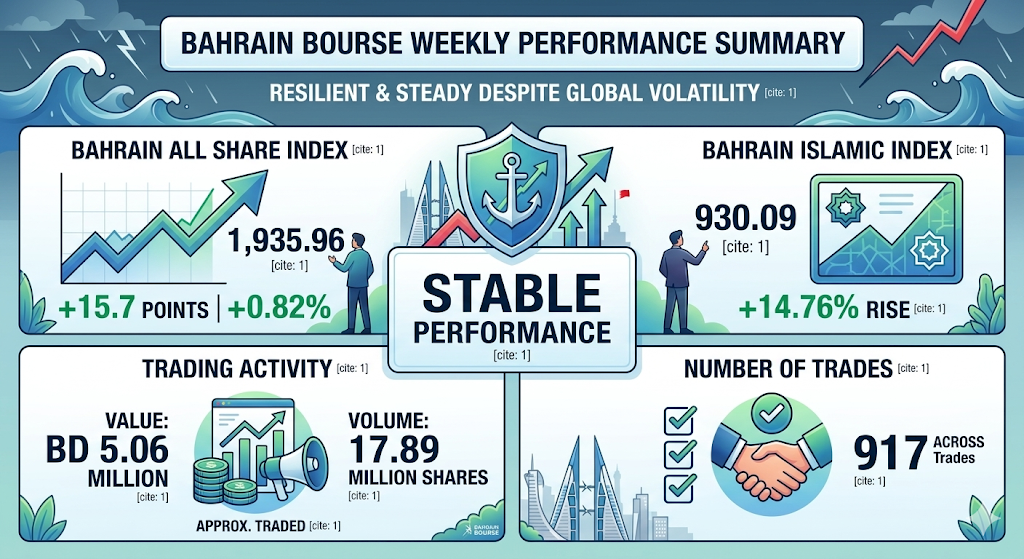
Despite increased global volatility, Bahrain Bourse maintained a relatively stable and defensive performance during the week. The Bahrain All Share Index closed at 1,935.96, gaining 15.7 points (+0.82%), while the Bahrain Islamic Index rose to 930.09, up 14.76% for the week. Total traded value reached approximately BD 5.06 million, with trading volume of 17.89 million shares across 917 trades.
Investor activity remained concentrated in banking, investment, and selected real estate stocks, with GFH Financial Group, Salam Bank, BBK, and SEEF among the most actively traded securities. Meanwhile, SEEF Holding, Esterad, and BISB led weekly gains.
Commodities: Oil Surges Above $100, Gold Softens, Crypto Remains Volatile
Oil prices rose sharply during the week as geopolitical tensions intensified across the Middle East and concerns grew over possible supply disruptions near the Strait of Hormuz. Brent Crude reached approximately $107–109 per barrel while WTI Crude rose to approximately $101–105 per barrel.
Gold prices softened modestly during the week, approximately $4,540–$4,660 per ounce, despite heightened geopolitical uncertainty. Rising U.S. Treasury yields and a firmer U.S. dollar limited investor demand for non-yielding safe-haven assets.
Bitcoin traded broadly within the $78,000–80,000 range during the week, while overall cryptocurrency markets remained volatile and sentiment-driven.
What Moved Markets This Week?
- Rising Oil Prices and Geopolitical Tensions: Renewed tensions involving Iran and uncertainty surrounding the Strait of Hormuz significantly impacted global market sentiment and pushed oil prices above $100 per barrel.
- Treasury Yield Pressure: Higher Treasury yields increased pressure on equity valuations, particularly across growth and technology sectors.
- Technology Sector Consolidation: After several weeks of strong gains, AI and semiconductor-related stocks experienced profit-taking activity, slowing broader market momentum.
Key Takeaways for the Week
- Global markets experienced higher volatility as oil prices surged above $100 per barrel.
- Technology stocks paused after several weeks of AI-driven gains.
- Rising Treasury yields pressured growth-oriented equities.
- GCC markets remained relatively stable due to stronger oil prices.
- Bahrain maintained its defensive and low-volatility market profile.
- Oil strengthened significantly, while gold weakened during the week.
- Crypto markets remained range-bound and sentiment-driven.
Overall Market View
The week ending 15 May 2026 highlighted the growing influence of geopolitical developments, energy markets, and bond yields on investor sentiment. While long-term optimism surrounding artificial intelligence and technology remains intact, markets are becoming increasingly sensitive to inflation risks, higher financing costs, and global supply concerns.
For GCC markets, elevated oil prices continue to provide underlying support, although geopolitical uncertainty remains a key limitation to stronger market momentum. Bahrain’s steady and stable performance once again reinforced its position as a defensive investment market within the GCC region.
Sources: AP News, Reuters, Bahrain Bourse, Bureau of Labor Statistics, Federal Reserve, Dubai Financial Market, Investing.com, Investrade, Yahoo Finance, Zawya by LSEG.
Compiled & edited by: Dr. Tanvir Mahmoud Hussein, Associate Professor (Finance).


Last Updated: 3 June 2026