
May 2026
From Drones to Medical Applications: How BLDC Motors Drive Modern Innovation
Dr. Osama Al-Rawi

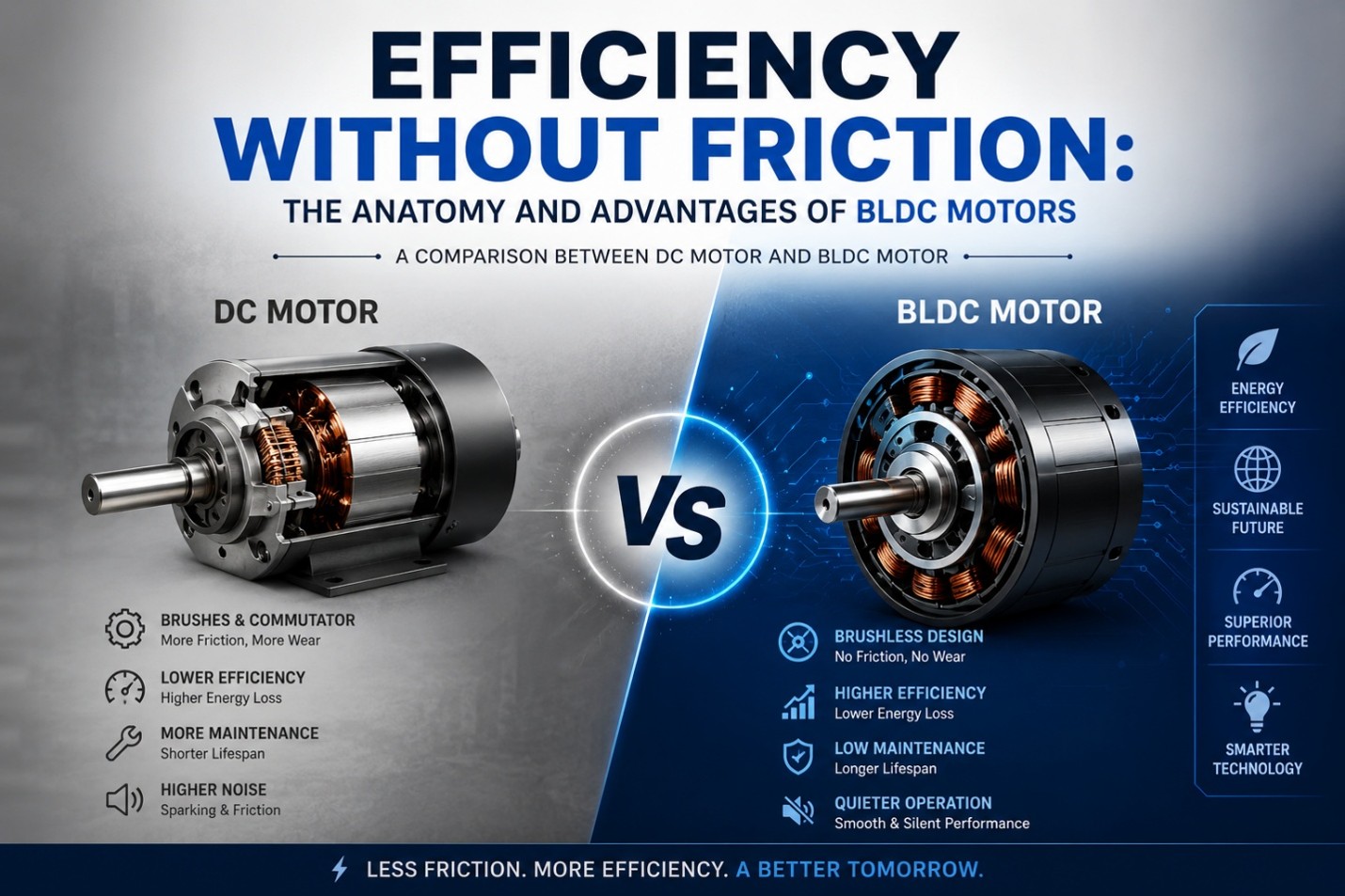
Brushed motors were, by their very nature, designed to fail—burning themselves out from the inside through friction, heat, and sparks. Explore how the Brushless DC (BLDC) motor swaps mechanical contact for semiconductor intelligence to unlock 90% efficiency, near-zero inertia, and silent, slip-free motion.
Every time you use a laptop, adjust a power seat in a car, or start a high-end espresso machine, you are activating a tiny, invisible workforce. For over a century, this workforce relied on “brushed” motors—19th-century machines that were, by their very nature, designed to fail. Traditional motors are a chaotic environment of mechanical friction, carbon dust, and literal sparks. They are essentially burning themselves out from the inside, trading longevity for a simple, low-cost connection.
But a quiet revolution has arrived. The Brushless DC (BLDC) motor has begun replacing these friction-prone relics with something far more elegant: pure, logic-driven motion. By swapping mechanical parts for semiconductor intelligence, BLDC technology has become the sophisticated solution to our modern demand for silent, efficient power. To understand why this matters, we have to look past the casing and see how “opening the black box” of the motor reveals a fundamental shift in how we move the world.
In a traditional DC motor, mechanical brushes maintain physical contact with a commutator to deliver electricity to the spinning rotor. This is a design of inherent compromise. The mechanical contact creates a significant “voltage drop across brushes,” leading to heat and energy loss. Consequently, brushed motors typically peak at a moderate 75–80% efficiency.
BLDC motors achieve the “holy grail” of motor design by flipping the architecture. The permanent magnets reside on the rotor, while the copper windings are moved to the stationary stator. This eliminates mechanical contact entirely. By removing the brushes, engineers have pushed efficiency into the 85–90% range. Beyond the energy savings, this removal eliminates the “arcs” that generate electromagnetic interference (EMI) and noise.
The most immediate industrial impact, however, is the liberation of speed. Without brushes to wear down or create drag, the mechanical ceiling vanishes:
“Due to the absence of brushes BLDC motors are capable to run at high speeds.”
A critical but often overlooked advantage of BLDC motors is their superior dynamic response. In traditional induction motors, the rotor is heavy, often laden with windings or thick cores. In a BLDC motor, the rotor is a compact permanent magnet. This creates a “low-inertia” environment, allowing the motor to accelerate and decelerate almost instantly, drastically shortening operating cycles in industrial automation.
Furthermore, unlike AC induction motors, BLDC motors experience no “slip”—the rotor and the magnetic field of the stator are always in perfect sync.
| Feature | AC Induction / Brushed Motors | BLDC Motors |
|---|---|---|
| Speed/Torque | Non-linear; lower torque at low speeds. | Flat: Enables operation at all speeds with rated load. |
| Rotor Inertia | High; poor dynamic response. | Low: Better acceleration and deceleration. |
| Slip | Rotor runs at a lower frequency than stator (slip increases with load). | No Slip: Stator and rotor frequencies are identical. |
| Starting Current | High: Up to 7× rated current (requires Star-Delta starters). | Rated: No special starter circuit required. |
| Interference | High EMI and Arcs (in brushed models). | Low EMI: Quiet, “clean” electronic operation. |
The Brushless DC motor is no longer a luxury of high-end tech; it is the cornerstone of a sustainable, high-performance future. By ruthlessly engineering out the physical limitations of the brush, we have unlocked a level of efficiency and longevity that was once thought impossible.
As we look toward the next generation of industrial design, the BLDC revolution serves as a blueprint for optimization. It leaves us with one compelling question: If we can achieve 90% efficiency by simply removing physical contact, what other “frictions” in our modern technology are waiting to be engineered out of existence?
Dr. Osama Yaseen Al-Rawi
Associate Professor, Electrical and Electronic Engineering, College of Engineering — Gulf University, Bahrain
Last Updated: 13 Jun 2026
